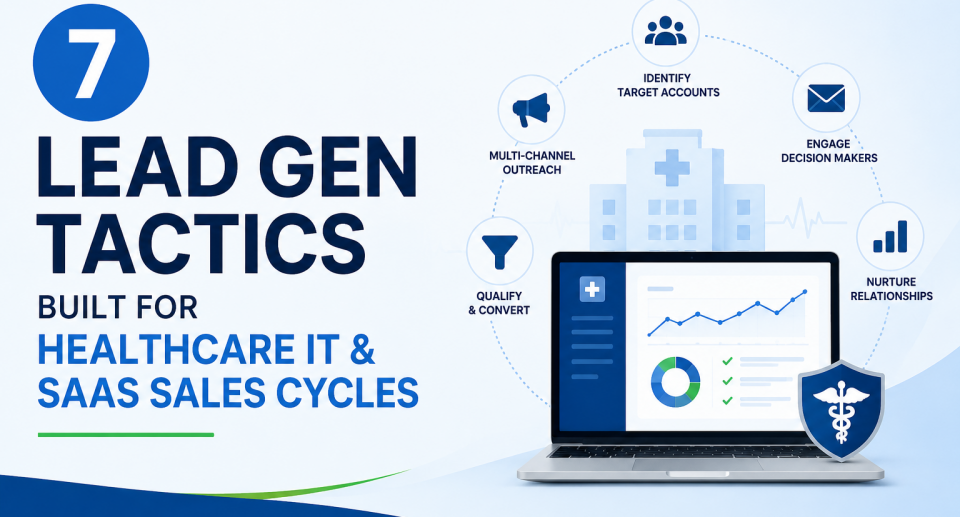
7 Lead Gen Tactics Built for Healthcare IT & SaaS Sales Cycles

Your CFO is asking why your healthcare IT pipeline is moving more slowly than in your other verticals. The honest answer: it is. The average healthcare technology sales cycle runs 9 to 12 months, with enterprise health system deals routinely stretching past 18.
Your generic SaaS lead gen playbook, the one optimized for an 84-day cycle, is silently breaking every quarter you run it.
The fix is not more leads. It is different leads, captured at different moments, and qualified against different gates.
Key Takeaway: Healthcare IT buying has three parallel decision tracks (clinical, IT/security, procurement) and a hard compliance gate. Lead gen tactics that win here are built around those tracks, not around generic MQL volume.
1. Map the Three-Buyer Reality Before You Spend a Dollar
Most healthcare IT vendors run their lead gen as if there is one buyer with a budget. There are three. They report to different executives, are evaluated on different criteria, and often disagree with each other before they ever talk to you.
The clinical buyer (Chief Medical Officer, Chief Nursing Officer, service line director) cares about workflow disruption, patient outcomes, and whether your product makes their day harder or easier.
The IT buyer (CIO, CISO, Director of Clinical Informatics) cares about integration, security posture, and whether your product will create a 3 AM page.
The procurement buyer (VP Supply Chain, Contracts) cares about GPO alignment, total cost of ownership over the contract term, and how cleanly your paper moves through legal.
The Numbers: According to a 2024 Bain & Company healthcare IT buyer study, 71% of provider technology purchases involve five or more stakeholders, and decisions are 2.4x more likely to stall when vendors engage only one persona. Most published industry sources estimate the average enterprise healthcare IT sales cycle at 9 to 12 months.
If your lead-gen funnel feeds only one of these three personas, your conversion rate is capped by the two you ignored.
The fix is structural. Build three intake paths, not one. Clinical content (workflow case studies, peer-reviewed citations, KLAS scores) lives in one funnel. IT content (architecture diagrams, HITRUST/SOC 2 documentation, EHR integration specs) lives in another.
Procurement content (TCO calculators, GPO contract references, paper-to-signature timelines) lives in a third. The accounts that progress are those in which all three intake paths fire on the same logo within 60 days. That is your real MQL.
2. Capture Clinical Champions Where They Actually Read
Clinical buyers are not on LinkedIn at 11 AM scrolling B2B SaaS thought leadership. They are charting, in rounds, or in the OR. When they do consume content, they consume it in three places: peer-reviewed journals, specialty society publications, and clinician-specific networks like Doximity and Sermo.
Your standard demand-gen stack (LinkedIn ads, gated whitepapers, paid search for “healthcare IT software”) will not reach them.
It will reach the analyst doing the comp review three months into the deal. By then, the clinical champion either exists or does not, and you had nothing to do with creating one.
The tactic that works: place authored content, not advertising, in the venues your clinical buyer already trusts. A 1,200-word implementation case study in a specialty society newsletter, co-authored with a CMIO customer, generates more qualified clinical interest than $40,000 in LinkedIn impressions targeting “healthcare executive.”
Three specific moves to run this quarter:
- Sponsor one peer-reviewed journal supplement or special issue per year in your top clinical specialty. Co-write with a current customer. The reprint becomes a sales asset for the next 24 months.
- Run a quarterly Doximity-targeted campaign featuring a clinical champion’s video testimonial. Doximity’s targeting filters down to specialty, hospital size, and role precision that LinkedIn cannot match for clinicians.
- Build a “clinician advisor” program of 8 to 12 paid (modestly, $1,500 to $5,000/year) CMOs and CNIOs who co-author content with you and refer peers.
Clinical buyers do not respond to vendor content. They respond to peer content that happens to mention a vendor.
3. Pre-Clear Compliance to Compress the Security Review
The single longest gate in a healthcare IT sale is not procurement. It is the security and compliance review. A typical health system security review takes 60 to 120 days. Some run longer than the rest of your sales cycle combined.
You cannot eliminate this review. You can absolutely shortcut it. Health systems give procedural credit, sometimes dramatic credit, to vendors who arrive with their answers pre-packaged in the formats their security teams already use.
Specifically, that means: a current HITRUST CSF certification (not “in progress”), a SOC 2 Type II report less than 12 months old, a completed HECVAT (Higher Education Community Vendor Assessment Toolkit, increasingly used by health systems), and a pre-filled Cloud Security Alliance CAIQ.
Vendors who walk into a security review with all four shave an average of 30 to 60 days off the review timeline, according to widely reported benchmarks from health system CISO panels.
The Numbers: KLAS Research’s 2024 cybersecurity report notes that HITRUST-certified vendors are 3x more likely to clear initial security review without escalation, and health systems increasingly use HITRUST status as a pre-qualification gate before any technical evaluation begins.
Turn this into a lead gen tactic, not just a sales asset. Build a public “trust center” page that lists every certification with dates and downloadable summaries (gated by email for the full documents).
This page will quietly become one of your highest-converting traffic destinations, because every healthcare IT buyer Googles “Email Dat Group HITRUST” before they take a first call.
A trust center page with current certifications converts mid-funnel buyers better than any whitepaper you will ever write.
4. Build a Reference Library That Speaks IT’s Language
Healthcare CIOs do not trust marketing language. They trust other healthcare CIOs. Reference selling is not a closing tactic in healthcare IT. It is a top-of-funnel tactic that determines whether you get the first meeting.
Most vendors treat references as a late-stage resource: “We’ll connect you with a customer once you’re in evaluation.” That is too late. By the time a CIO is in formal evaluation, they have already short-listed based on peer reputation, and you may not be on the list.
The shift: build a reference library that is partially public, segmented, and discoverable.
Structure it in three layers.
Layer 1 is public: anonymized case studies with quantified outcomes (“420-bed regional system reduced clinical documentation time by 31% in 6 months”).
Layer 2 is gated: named case studies with the customer’s logo and a quote, downloadable behind a soft form.
Layer 3 is private: a list of named reference customers, sortable by EHR vendor, hospital size, and use case, accessible only to qualified opportunities.
Three rules for executing this:
- Every quarter, retire case studies older than 24 months unless the customer is still actively expanding. Stale references hurt more than they help.
- Pair every case study with a named clinical and IT contact at the customer, not just a logo. The CIO reading it wants to know who they can call.
- Track which case studies get downloaded by which accounts. A CIO who downloads three case studies from one EHR ecosystem in a week is a signal, not noise.
Reference selling done well replaces 30 to 40% of your traditional cold outbound, because the references are doing the outbound for you.
5. Use Event-Window Intent (Not Just Event Booths)
HIMSS, ViVE, HLTH, and the major specialty society meetings are not just places to put a booth. They are intended windows.
Healthcare IT buyers research vendors in concentrated bursts in the 60 days before and 30 days after these events. If your only event strategy is the booth, you are capturing 5% of the available signal.
The smarter play is to treat each major event as a 90-day campaign with three phases.
Phase 1 (60 to 30 days pre-event): Run content campaigns that target the specific clinical and IT topics on the agenda. Buyers attending HIMSS are searching ahead for sessions and vendors. Rank for those queries with practical content, not “Why You Should Visit Our Booth at HIMSS” filler.
Phase 2 (30 days pre-event through event week): Layer intent data (Bombora, G2 buyer intent, 6sense) over your target account list. Accounts spiking on relevant topics in the two weeks before HIMSS are 4 to 5x more likely to take a meeting at the event than accounts targeted by spray-and-pray meeting outreach.
Phase 3 (event week to 30 days post): The booth is not the highest ROI activity. The highest ROI activity is the structured follow-up cadence in the 14 days after the event, when buyers are back at their desks reviewing notes and looking up the three vendors they actually remembered.
Most vendors capture 100% of their event ROI from 5% of their event budget. The event budget is for the booth. The ROI is everything that happens around it.
6. Co-Sell Through Integration Partners, Not Around Them
Every meaningful healthcare IT sale involves an EHR. Epic, Oracle Health (Cerner), MEDITECH, athenahealth, and a long tail of specialty EHRs gatekeep nearly every health system technology decision. Vendors who treat EHR integration as a technical afterthought get treated as a technical afterthought.
Vendors who treat the EHR partnership as a go-to-market channel unlock a pipeline that they cannot generate any other way.
Concretely: Epic’s App Orchard / Showroom, Oracle Health’s developer network, athenahealth’s Marketplace, and SMART on FHIR app directories are not just listings. They are referral engines used by health system CIOs and informaticists during vendor selection.
A health system shopping for a clinical decision support tool will filter the App Orchard before they Google “best clinical decision support vendor.”
Three moves that work:
- Invest the engineering time to achieve a verified, certified integration with at least one major EHR. “We can integrate” is not the same as a listed, certified integration.
- Co-author technical implementation content with the EHR partner. These pieces rank well organically and get distributed through partner channels.
- Build joint customer case studies that name both vendors. EHR vendors actively promote partners whose case studies make the EHR look good.
The Numbers: A 2023 Bessemer Venture Partners healthcare IT report estimated that vendors with certified integrations to a major EHR close at 2.1x the rate of non-integrated competitors in head-to-head deals, and the integration cuts an average of 45 days off implementation timelines.
In healthcare IT, your EHR partnership status is a top-of-funnel asset, not just a sales enablement footnote.
7. Turn Procurement Into a Pipeline Stage, Not a Surprise
The deals that die in healthcare IT do not die because the product was wrong. They die because procurement showed up at month 7 with a 40-page contract review, GPO alignment questions, and a master services agreement template the vendor had never seen.
The deal does not actually die. It enters a 90-day legal review and slips two quarters.
The fix is to treat procurement engagement as a pipeline stage rather than a closing milestone. The accounts that close on time are those in which procurement was engaged by week 4 of the evaluation, not week 24.
Build a procurement-facing content track and qualification motion alongside your clinical and IT tracks. Specifically:
- Maintain a public list of GPO contracts you hold (Premier, Vizient, HealthTrust). Health systems aligned with those GPOs can contract 40-60% faster.
- Build a TCO calculator that procurement teams can use directly. Procurement leaders will not download a sales calculator. They will use one built for their workflow.
- Offer a “procurement pre-read” packet (insurance certificates, BAA template, security summary, contract terms summary) that closes the most common procurement questions in one document.
The leading indicator that a deal will close on time is not the clinical champion’s enthusiasm. It is whether procurement has the pre-read packet by week 6.
Engage procurement at the MQL stage, not at the SQL stage. The deals you accelerate are the ones where procurement never has a surprise.
The Shift: From Volume to Velocity
Healthcare IT lead gen is not broken because the tactics are wrong. It is broken because the tactics imported from generic B2B SaaS assume a buying cycle that does not exist here.
Applying 84-day cycle tactics to 270-day cycles results in inflated MQL counts and depressed close rates. That is the gap most healthcare IT marketing dashboards quietly hide.
The seven tactics above are not a checklist. They are a system. They work because each one targets a specific structural reality of healthcare IT buying: the three-buyer split, the clinical media gap, the compliance gate, the reference economy, the event intent window, the EHR channel, and the procurement landmine.
Run any one in isolation, and you will see modest gains. Run them as a connected pipeline, where clinical content feeds IT enablement, which feeds compliance pre-clearance, which feeds procurement readiness, and you will compress 12-month cycles into 7 or 8.
The shift is from generating more leads to engineering a faster pipeline. The teams winning in healthcare IT in 2026 are not the ones running the most outbound. They are the ones whose pipeline moves through the buying cycle’s natural choke points without stalling at any of them.
Run a one-quarter audit of your healthcare IT pipeline against these seven tactics. Score each tactic from 0 to 3 based on how mature your motion is. Any tactic scoring 0 or 1 is a stall point you are paying for every quarter you ignore it.