Anatomy of a High-Converting B2B Email List: What Separates a Pipeline Asset from an Expensive Bounce Machine

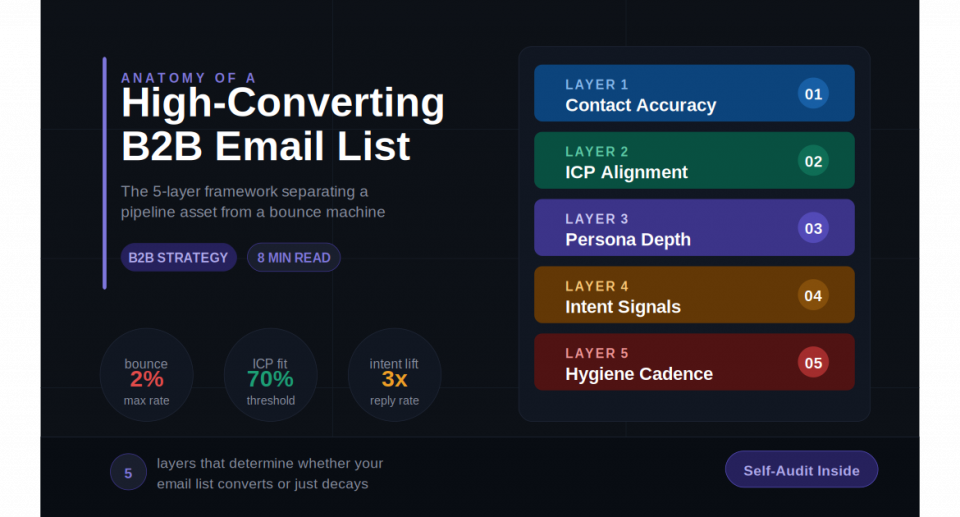
Most B2B email lists don’t fail because of bad copywriting. They fail because the list itself was never built to convert in the first place.
4.9 on G2
Quick Summary for Skimmers
- A high-converting B2B email list is not just a collection of contacts. It is a structured, verified, segmented intelligence asset.
- The five core components that determine list conversion rate: contact accuracy, ICP alignment, persona depth, intent signals, and hygiene cadence.
- Most lists underperform because they optimize for volume instead of fit. A list of 500 tightly qualified contacts will outperform a list of 10,000 broadly scraped ones every single time.
- Skip to the 5-Layer Framework section if you need the tactical breakdown now.
The Uncomfortable Truth About Your Email List
Picture this: your SDR sends 200 emails on Monday morning. By Tuesday, 18 bounce back hard. Another 30 go to generic info@ addresses. Twelve more reach contacts who left those companies six months ago. Of the remaining 140, maybe 8 actually match the persona you were targeting.
That is a 4% effective reach rate. Not a 4% reply rate. A 4% rate of even reaching the right person.
This is not a copywriting problem. It is not a subject line problem. It is a list architecture problem. And it is far more common than most revenue teams admit, because the failure mode is invisible. The emails go out, the metrics look “okay,” and nobody connects the low booking rate back to the fact that the foundation was rotten from day one.
A high-converting B2B email list is not a spreadsheet of names and email addresses. It is a deliberately constructed intelligence asset with five distinct layers, each one doing a specific job. Strip any one of those layers out, and the whole thing underperforms.
Here is exactly what those layers are, why each one matters, and how to audit yours right now.
Layer 1: Contact Accuracy — The Layer Everyone Underestimates
If the email does not reach a real person at a real company, everything else is irrelevant.
B2B contact data decays at approximately 22-30% per year, according to research from Dun & Bradstreet and Salesforce. That means a list you built or purchased 18 months ago has already lost nearly half its accuracy. People change jobs. Companies get acquired. Roles get eliminated. Domains expire.
Contact accuracy has three dimensions that most teams treat as one:
Email deliverability: Will this address accept the email without bouncing? This is the most basic check and the most commonly skipped. Every contact on your list should be verified using a real-time email validation tool (ZeroBounce, NeverBounce, or your data provider’s built-in verification) before it enters any sequence. A hard bounce rate above 2% is a red flag. Above 5%, your domain reputation is actively being damaged.
Role accuracy: Is this person still in the role you think they are? A CFO who moved to a new company three months ago is no longer your target. The person who replaced them might be. Role accuracy requires either a data provider that refreshes contact records continuously or a manual verification step for high-priority accounts.
Direct contact quality: Generic emails like info@, contact@, or hello@ are list killers. They go to shared inboxes, get triaged by gatekeepers, and almost never convert. Your list should be built on direct work emails and, where available, verified direct dials. If more than 15% of your list is generic addresses, you have a quality problem.
Audit check: Pull your last 3 outbound campaigns. Calculate hard bounce rate, soft bounce rate, and the percentage of replies that came from the intended decision-maker vs. an assistant or wrong contact. If you cannot pull these numbers, your tracking infrastructure is the first thing to fix.
Layer 2: ICP Alignment — The Layer That Determines Your Ceiling
The best-written email sent to the wrong company is still a waste.
ICP alignment is where most teams think they are doing fine and are actually doing terribly. Having a documented ICP does not mean your list reflects it. The gap between “we target mid-market SaaS companies” and “every contact on this list is a decision-maker at a mid-market SaaS company with the right revenue, headcount, and tech stack” is enormous. Most lists live somewhere in that gap.
A truly ICP-aligned list is built on at least four firmographic filters applied simultaneously:
Company size: Not just headcount. Revenue range matters more for most B2B solutions, and the two do not always correlate. A 50-person fintech startup with $20M ARR is a fundamentally different buyer than a 50-person regional manufacturing firm. Be precise about which metric your ICP is based on.
Industry and sub-industry: “Technology” is not an industry. “Cloud infrastructure software for financial services firms” is an industry. The more specific your vertical filter, the higher your relevance score will be for each recipient. Industry specificity also protects deliverability, because recipients in a tight niche are more likely to engage or unsubscribe cleanly rather than mark as spam.
Geography and compliance zone: Not just for targeting relevance, but for legal reasons. A contact in the EU requires GDPR-compliant outreach. A contact in California triggers CCPA considerations. Your list segmentation must encode this information, or you are one complaint away from a deliverability crisis.
Technographic fit: This is the filter most teams skip, and it often predicts conversion best. If your product integrates with Salesforce, a company running HubSpot as its primary CRM is a harder sell. If you replace legacy ERP systems, targeting companies already running modern ERP is wasted effort. Technographic data lets you filter for accounts where your solution fits the existing stack rather than fights it.
The ICP alignment test: Take 20 random contacts from your list. Score each one against your ICP criteria. How many score 4 out of 4 on all dimensions? If the answer is fewer than 14 out of 20 (70%), your list has an ICP alignment problem, not a messaging problem.
Layer 3: Persona Depth — The Layer That Determines Relevance
Reaching the right company means nothing if you are emailing the wrong person inside it.
Even within a perfectly ICP-matched account, there are typically 6-10 people involved in a B2B buying decision (Gartner, 2023). The person who signs the contract is rarely the person who discovers the problem. The person who discovers the problem is rarely the person who evaluates the solution. Your email list needs to reflect this reality.
Persona depth means having three things for every contact record:
Job title plus seniority level: “Marketing Manager” and “VP of Marketing” are not interchangeable targets. Neither is “Software Engineer” nor “Director of Engineering.” Your sequence strategy, messaging angle, and expected conversion rate all differ by seniority. A list that mixes these without segmentation will underperform because you are sending the wrong message to the wrong level.
Functional role in the buying process: Is this person an economic buyer, a technical evaluator, a champion, or an end user? Each role responds to different angles. Economic buyers care about ROI and risk. Technical evaluators care about integration and security.
Champions care about internal credibility and being the person who brought in the solution that worked. Tagging your contacts with a buying role lets you send the message that actually moves them.
Department alignment: Similar titles across different departments can have entirely different buying contexts. A “Director of Operations” at a logistics company versus a “Director of Operations” at a SaaS company are solving completely different problems. Department context sharpens relevance beyond the title alone.
The persona depth gap in most lists: They have a title. They do not have seniority context, buying role, or department nuance. The result is sequences that feel generic because they are generic. You cannot personalize at scale without structured persona data. Personalization tokens alone — first name, company name — do not fix a shallow persona problem.
Layer 4: Intent Signals — The Layer That Determines Timing
The right message to the right person at the wrong time is still a no.
Timing is the most underrated conversion variable in B2B email outreach, and it is the one layer almost no list has built in by default. Intent signals change a static list into a dynamic, prioritized pipeline by telling you which accounts are actively in a buying motion right now.
There are four categories of intent signals worth tracking:
Third-party intent data: Platforms like Bombora, G2, and TechTarget track content consumption across the web. When a company’s employees start reading articles about your category, it is a signal that they’re researching a purchase. Overlaying this data onto your list lets you prioritize the 200 accounts with active intent over the 8,000 without it. Outreach to in-market accounts yields 2-3x higher reply rates than cold outreach without an intent signal (Bombora, 2024).
Trigger events: Job changes, funding rounds, new executive hires, product launches, and acquisitions are all signals that a company’s buying priorities are shifting. A new VP of Sales is likely to evaluate the entire sales tech stack in their first 90 days. A Series B announcement means the budget has just grown, and headcount is about to increase. These triggers are publicly available via tools such as LinkedIn, Crunchbase, and news monitoring services. The teams building them into list prioritization are seeing dramatically higher connect rates.
Website engagement signals: If you have retargeting pixels or IP identification tools (Clearbit Reveal, Leadfeeder, 6sense), companies visiting your pricing page or solution pages are hotter leads than companies that have never interacted with your brand. This data should flow directly into your list prioritization logic.
CRM re-engagement signals: Contacts who opened but never replied, opportunities that stalled six months ago, or contacts from churned accounts who are now at new companies. These are warm signals hiding inside your existing data. A list that incorporates CRM history into its sequencing logic will always outperform one that treats every contact as equally cold.
The intent signal test: Sort your current outbound list by reply rate. Now look at the top 10% of responders. What do they have in common? Funding stage? Recent job changes? Specific tech stack? Industry vertical? The answer to that question is your intent signal layer. Build it in deliberately next time instead of discovering it in the data after the fact.
Layer 5: Hygiene Cadence — The Layer That Protects Everything Else
A list without a hygiene process is not an asset. It is a liability that compounds over time.
The four layers above get you to a high-quality list at the moment of creation. Hygiene is what keeps it that way. Without an active hygiene process, every list degrades on a predictable schedule. The question is not whether your list is decaying. It is whether you are managing that decay or letting it silently destroy your deliverability and your conversion rates.
A functional hygiene cadence operates on three timeframes:
Before every campaign: Run the active send list through email verification. Flag and suppress hard bounces from previous sends. Check for unsubscribes and opt-outs against your master suppression list. This should take less than 30 minutes for any list with fewer than 10,000 contacts, and it should be a non-negotiable gate before any sequence launches.
Monthly: Audit for contacts who have changed roles or companies using your data provider’s change detection features. Re-verify contacts that have not been mailed in more than 90 days. Review engagement metrics by contact segment to identify which persona or firmographic groups are underperforming, and investigate whether the issue is data quality or messaging.
Quarterly: Full ICP realignment audit. Pull a random 10% sample and score against the current ICP criteria. If your ICP has evolved (and it should), update your list segmentation to reflect it. Purge contacts from accounts that have churned, been acquired by non-ICP companies, or shrunk below your size threshold. Add net-new accounts that have entered your ICP since the last audit.
The teams that treat hygiene as a quarterly infrastructure task rather than a crisis response to deliverability problems are the ones with a consistent pipeline. Deliverability damage is exponentially harder to recover from than it is to prevent. Three months of neglected hygiene can produce six months of suppressed inbox placement.
The 5-Layer Framework at a Glance
| Contact Accuracy | Ensures emails reach real inboxes | What is your hard bounce rate on the last 5 campaigns? |
| ICP Alignment | Ensures you are targeting the right companies | What percentage of your list scores 4/4 on ICP criteria? |
| Persona Depth | Ensures the right message reaches the right level | Do you have seniority, buying role, and department for every contact? |
| Intent Signals | Ensures timing is right | Are you prioritizing contacts showing active buying signals? |
| Hygiene Cadence | Keeps the first four layers intact | When did you last run a full list verification? |
A list that scores well on all five layers does not just convert better. It also protects your sender reputation, reduces wasted SDR cycles, and gives your AI-assisted personalization tools the clean data they need to actually work. Automated sequencers and AI writing tools fail silently on dirty lists. The output looks personalized, but the targeting is wrong, and the timing is off. The tools are only as good as the data powering them.
What to Do Monday Morning
You do not need to rebuild your entire list to start improving it. Run this 4-step triage on your current list before your next campaign:
Step 1: Export your full send list and run it through a real-time email verifier. Suppress anything that comes back as invalid, risky, or catch-all. Note the percentage that flagged. If it is above 15%, your list has a serious accuracy problem.
Step 2: Pick 20 random contacts. Manually check their current role on LinkedIn. How many are still in the role they’re tagged as? If fewer than 16 out of 20, your role accuracy is below threshold.
Step 3: Count how many contacts have at least one intent signal attached: a recent job change, a funding event, a tech stack match, or content engagement. If the answer is zero, prioritization is your biggest missed opportunity.
Step 4: Check when you last ran a hygiene pass on the full list. If the answer is more than 60 days ago, schedule one before sending anything else.
The result of this triage will tell you which of the five layers needs the most immediate attention. Fix the highest-priority layer first. Do not send another campaign until you do.
The Bottom Line
A high-converting B2B email list is not a commodity you buy once or a spreadsheet you build once. It is a living system with five distinct layers, each requiring ongoing attention. The teams outperforming their peers on email outreach are not doing it with better subject lines. They are doing it with better data architecture.
Get the architecture right, and the copywriting almost takes care of itself. You are writing to the right person at the right company at exactly the right moment. That context does most of the persuasion work before the first word is read.
Get it wrong, and no amount of A/B testing subject lines will save you.
Key Takeaways
- Contact accuracy is table stakes. A bounce rate above 2% is actively damaging your domain reputation.
- ICP alignment determines your ceiling. Volume without fit is not a pipeline strategy.
- Persona depth enables relevance. The title alone is not enough. You need seniority, a buying role, and a department.
- Intent signals determine timing. In-market contacts convert 2-3x better than cold contacts with no signal.
- Hygiene cadence is infrastructure, not cleanup. Treat it that way.
- The five-layer compound. A list that scores well on all five does not convert 5x better. It converts dramatically better because each layer multiplies the effect of the others.