In-House List Building vs. Buying a Curated Database: Which One Actually Fills Your Pipeline?

The real question isn’t “which is cheaper?” It’s “which one gets your reps in front of the right people faster — without destroying your sender reputation in the process.”
Quick Summary for Skimmers
- In-house list building gives you control and long-term asset value, but it’s slower, resource-intensive, and often underestimates the true cost of maintenance.
- Purchased databases give you speed and scale, but quality varies wildly — and a bad list can tank your email deliverability for months.
- The winners aren’t choosing one or the other. They’re building a hybrid engine that uses purchased data to move fast and in-house enrichment to stay sharp.
- Skip to the Decision Framework section if you need an answer today.
The Debate Nobody’s Having Honestly
Every revenue team has this conversation at some point. Usually it sounds like this:
“We need more pipeline. Should we buy a contact list or build one ourselves?”
And then someone says, “Build it ourselves, that’s more sustainable,” and someone else says, “We don’t have time, let’s just buy a list,” and the decision is made based on whoever argued loudest in the meeting, not on actual data.
The honest truth? Both approaches fail when executed poorly. Both work when executed well. The difference is knowing when each approach is right for your stage, your team, and your motion.
Check out out: B2C email list
This isn’t a debate about philosophy. It’s about where your reps’ time goes, what your data quality looks like six months from now, and whether your outbound motion can actually scale.
Let’s break it down.
What “In-House List Building” Actually Means
When people say they’re building their list in-house, they usually mean one of three things:
- Manual research: SDRs or a dedicated ops person is searching LinkedIn, company websites, and industry directories to compile contacts one by one.
- Tool-assisted scraping: Using tools like Sales Navigator, Clay, or Apollo to pull contacts based on filters, then manually enriching them.
- Intent-driven prospecting: Pulling contacts from platforms like Bombora or G2 that signal active buying behavior, then building around that signal.
These are not the same thing. The first is the most common and the most expensive when labor is factored in. The third is what high-performing GTM teams are doing.
The Real Cost of Building In-House
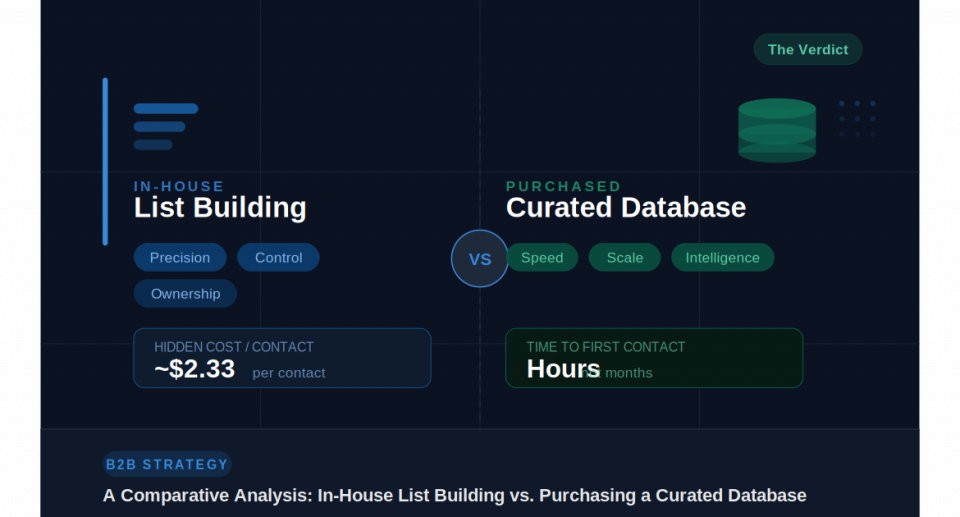
Here’s the math most people get wrong. Say your SDR earns $65,000/year. That’s roughly $31/hour. If that SDR spends 90 minutes building a 20-contact prospect list, your cost per contact is about $2.33 — before you factor in tools, management time, or the opportunity cost of every hour they’re not having conversations.
At scale? That math gets ugly fast.
The hidden costs no one accounts for:
- Data decay: B2B contact data decays at roughly 30% annually (source: Dun & Bradstreet). A list you built in January is already 8% stale by April.
- Deduplication and hygiene: Someone has to audit for duplicates, bounced emails, and contacts who’ve changed roles. That’s a part-time job in disguise.
- Tool sprawl: Most teams end up paying for 4-6 data tools simultaneously because no single one covers every persona or geography they need.
None of this means building in-house is wrong. It means most teams underestimate what it actually costs.
Where In-House Building Wins
In-house list building is genuinely superior in three scenarios:
1. Niche markets with hard-to-find personas. If you’re selling to, say, VP-level Infrastructure Security leads at mid-market fintech companies with a specific tech stack, no database will be fully dialed in to that stack. Manual research with the right filters will outperform any purchased list.
2. Account-based plays where depth matters more than breadth. When you’re running a tight ABM motion on 50 named accounts, you don’t need volume. You need every decision-maker, influencer, and champion mapped correctly. That granularity requires human judgment.
3. When your TAM is genuinely small. If your addressable market is 2,000 companies, buying a list of 50,000 contacts is noise. In-house research on your precise ICP will outperform every time.
What “Purchasing a Curated Database” Actually Means
Not all databases are created equal, and this is where most teams get burned.
There’s a spectrum. On one end, you have commodity-list vendors selling 500,000 contacts for $299 — contacts scraped two years ago, never verified, and now 40% outdated.
On the other end, you have purpose-built intelligence platforms that verify data in real time, layer in firmographic and technographic filters, and provide a confidence score for every contact.
The difference between buying a list and buying intelligence is everything.
A list gives you names and emails. Intelligence gives you:
- Verified direct dials and work emails (with bounce rate data)
- Firmographic context (revenue range, headcount, funding stage)
- Technographic signals (what tools they’re running)
- Intent data overlays (are they actively researching your category right now?)
- Contact confidence scores (how likely is this data to be current?)
When teams say “we bought a list, and it didn’t work,” they usually bought commodity contact data rather than curated intelligence. That’s like saying “I tried cooking and it didn’t work” after burning water.
Where Purchased Data Wins
1. Speed to market. If you’re launching a new product line, entering a new vertical, or ramping a new SDR, you cannot wait three months to build a list. A curated database lets you go from “we need contacts” to “our first sequence is live” in days, not quarters.
2. Coverage at scale. If your ICP is broad — say, “Director of Finance at companies with 100-500 employees in North America” — manual research will take forever and introduce inconsistency. A verified database can surface 10,000 qualified contacts overnight.
3. Competitive intel and market mapping. Purchased intelligence databases aren’t just for outbound. The best teams use them to map the total addressable market, identify whitespace, and benchmark their existing pipeline coverage. That’s strategic value that goes beyond just feeding sequences.
4. Testing new ICPs quickly. When you’re experimenting with a new persona or segment, you don’t want to invest 200 hours of research to find out the segment doesn’t convert. Purchase a targeted slice, run the test, and get the answer in weeks.
The Core Tradeoffs, Side by Side
| Speed to first contact | Weeks to months | Hours to days |
| Data freshness | High (at point of creation) | Variable (depends on vendor) |
| Accuracy for niche personas | High (human judgment) | Medium (filter-dependent) |
| Scale | Limited by team bandwidth | Nearly unlimited |
| Cost predictability | Low (hidden labor costs) | High (flat or usage-based) |
| Deliverability risk | Lower | Higher (if vendor quality is poor) |
| Long-term asset value | High (you own the data) | Low (license expires) |
| ABM depth | High | Medium |
The Question Teams Don’t Ask: What Happens to Deliverability?
This deserves its own section because it’s the one thing that can silently kill your outbound program.
When you send emails to bad contacts — people who’ve changed jobs, invalid addresses, or leads who never opted into anything relevant — your bounce rate climbs, spam complaints accumulate, and inbox providers start routing your domain to junk.
Damage to email deliverability can take 3-6 months to recover from. That’s 3-6 months of campaigns going nowhere while your team wonders why response rates tanked.
Check out B2B Email Lists
In-house lists, when built carefully, tend to have better deliverability because you’re researching each contact and can spot obvious red flags. Purchased lists carry more risk — but the risk is manageable if you:
- Always use a vendor that provides email verification (real-time bounce-rate data, not just a “valid” flag from six months ago)
- Warm up to any new list segment before scaling sends
- Run every purchased list through a third-party verification tool before uploading to your sequencer.
- Suppress anyone who’s been in your CRM before, even if they never responded.
Treat your domain like a credit score. Protect it.
A Decision Framework: Which One Should You Use Right Now?
Answer these four questions:
1. How tight is your ICP?
- Very specific (niche industry + specific title + specific tech stack) → In-house wins.
- Broad (any B2B company in a large segment) → Database wins.
2. How fast do you need the pipeline?
- Need results this quarter → Database.
- Building for a 12-month horizon → In-house infrastructure pays off.
3. What’s your SDR capacity?
- SDRs are spending more than 30% of their time on research → That’s a problem. Shift to purchased data.
- You have dedicated ops or a RevOps function managing enrichment → In-house can work at scale.
4. What’s your current data quality?
- CRM is clean, enriched, and maintained → You have a strong in-house foundation. Layer in purchased intent data as a supplement.
- CRM is a mess → Fix that first, regardless of which approach you choose for net-new prospecting.
What the Best Teams Actually Do
The top-performing outbound teams aren’t choosing sides. They’re running a hybrid motion that looks like this:
Layer 1: Purchased intelligence as the foundation. Start with a verified database to quickly cover broad ICPs. Use this to identify the companies in your TAM and surface the right contacts fast.
Layer 2: In-house enrichment for prioritization. Once you have a pool of accounts, layer on manual research to identify which accounts are showing buying signals, which have relevant triggers (new funding, new hire, tech change), and which deserve high-touch sequencing.
Layer 3: Intent data to sequence smarter. Overlay third-party intent signals to identify accounts actively researching your category. This is where purchased intelligence platforms earn their keep — the good ones do this natively.
Layer 4: Continuous hygiene as an ops function. Assign someone to own the data quality. Not as a side project. As their actual job. Data decay is constant. The team that treats hygiene as infrastructure wins.
The result: Your SDRs spend their time on conversations, not spreadsheets. Your sequences hit verified contacts. Your deliverability stays clean. And your pipeline data actually reflects reality.
The Verdict
If you’re early-stage and need to move fast: buy curated intelligence from a quality vendor. Be ruthless about vendor selection — verify that they refresh data regularly, provide bounce rate signals, and have technographic and firmographic filters that match your ICP. The $300 commodity list is a trap.
If you’re scaling and want a durable asset, invest in building an in-house research capability alongside your purchased data. The goal is a proprietary data layer that reflects your ICP, market, and signal set. Nobody else can replicate that.
If you’re already running outbound and results are declining, the problem probably isn’t which approach you’re using. It’s data quality. Audit your bounce rates, your contact-to-meeting ratios by data source, and how stale your CRM really is. Fix that before you spend another dollar on list-building either way.
The teams winning outbound in 2025 aren’t the ones with the biggest lists. They’re the ones with the most accurate lists, the most relevant triggers, and the most disciplined hygiene. That’s a process advantage. And the process advantages compound.
Key Takeaways
- In-house list building gives you precision and ownership, but it also carries hidden labor costs and data-decay risk that most teams underestimate.
- Purchased databases give you speed and scale, but vary wildly in quality — commodity lists hurt more than they help; intelligence platforms change the game.
- Deliverability is your most fragile asset. Protect it by treating data quality as infrastructure, not an afterthought.
- The winning motion is hybrid: purchased intelligence for speed and scale, in-house enrichment for depth, intent data for prioritization, and dedicated ops for hygiene.
- The question isn’t build vs. buy. It’s “What does our data engine need to look like to support the pipeline targets we actually have?”
Looking to audit your current data quality before making this decision? Start with a simple bounce rate check on your last 10 outbound sequences.
If you’re seeing more than 5% hard bounces, your data problem is already costing you pipeline — and it’s only getting worse.