Why Our NetSuite Users Database Has 95% Email Deliverability

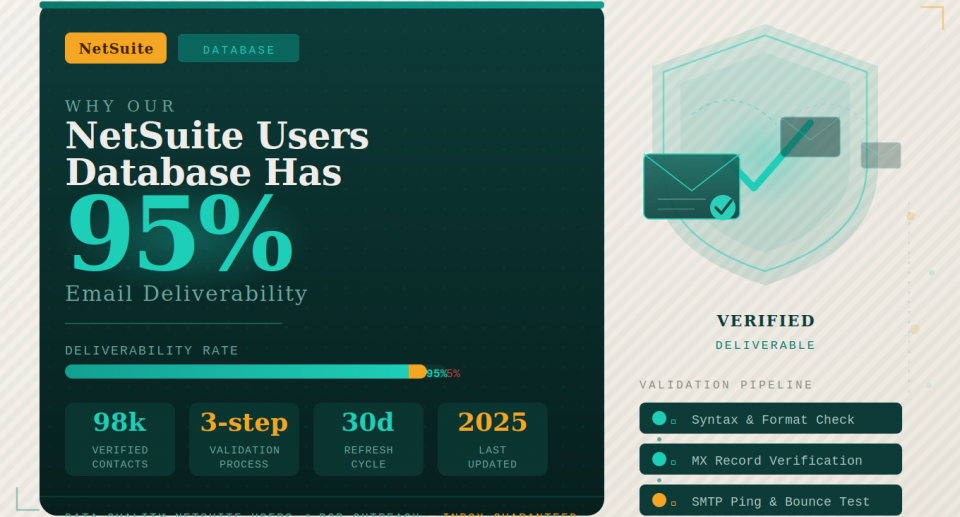
Key Takeaway: A 95% email deliverability rate on a NetSuite user’s database isn’t luck. It’s the output of a six-layer verification process that most data providers skip because it’s expensive and slow. This article explains exactly what that process looks like, why it matters for your pipeline, and what to ask any data vendor before you buy.
The Industry’s Dirty Secret: Most “Verified” Databases Deliver 60-70%
Here’s a number worth bookmarking: the average B2B contact database has an email validity rate of 60% to 70%, according to benchmarks from major data providers.
That means if you buy 1,000 NetSuite user contacts, 300 to 400 of those emails will bounce, go to inactive inboxes, or get flagged by spam filters before a human ever reads your message.
Your SDRs aren’t underperforming. Your data is.
The problem compounds when you’re targeting a specific technology install base, like NetSuite. These contacts require two layers of validation: the contact record itself AND the technology attribution linking that person to a NetSuite deployment. Get either wrong, and you’re emailing the wrong person at the wrong company with a message that assumes they use software they’ve never heard of.
We built our NetSuite users database to solve this. Here’s exactly how.
Why NetSuite Contact Data Goes Stale Faster Than Most
Before explaining our process, it’s worth understanding why NetSuite user data decays so aggressively.
NetSuite is predominantly used by mid-market and enterprise companies in their growth phase. These are companies with active hiring, rapid team expansion, and regular organizational restructuring. The people responsible for NetSuite deployments, finance directors, IT leads, and ERP administrators tend to be highly mobile in their careers.
Three data points that explain the decay rate:
- Finance and operations roles see 18-24% annual turnover at mid-market companies (Bureau of Labor Statistics, 2024)
- NetSuite implementations frequently trigger org changes, meaning the champion who signed the deal is often not the administrator 18 months later.
- Company-level NetSuite data (installed base) also shifts as companies upgrade, consolidate, or switch ERP vendors.
The result: a NetSuite contacts list scraped from LinkedIn or pulled from a data co-op in Q1 is already 15-20% decayed by Q3 of the same year.
Most data vendors don’t tell you this. They sell you the list, charge a flat fee, and let you discover the bounce rate yourself.
The Six-Layer Verification Stack Behind 95% Deliverability
Achieving 95% email deliverability on a niche technology install base requires more than email syntax checking. Here’s the full process we run on every record in our NetSuite users database before it’s available to a customer.
Layer 1: Install Base Verification
We start by confirming the technology signal, not the contact. Before anything else, we verify that the company actually runs NetSuite using three independent data sources: web technology crawling, job posting analysis (companies hiring for NetSuite-specific roles), and vendor partnership data.
A record enters the pipeline only if at least two of the three signals confirm active NetSuite usage. Single-source signals get quarantined.
Why this matters: Plenty of databases include companies that evaluated, piloted, or previously used NetSuite. We don’t. Our install base verification catches approximately 12% of records that would otherwise appear as valid NetSuite customers but aren’t active users.
Layer 2: Role and Title Relevance Mapping
Once we confirm the company is a live NetSuite environment, we map the contact to their function within the deployment. NetSuite users aren’t a monolith.
A CFO who signed the NetSuite contract is a different buyer than the NetSuite Administrator who runs daily operations, the IT Director who owns integrations, or the VP of Finance who relies on NetSuite for month-end close.
We tag every contact with their likely relationship to the NetSuite deployment: economic buyer, technical administrator, power user, or influencer. This allows your outreach to land with messaging calibrated to their actual use case, not a generic “NetSuite user” pitch.
Layer 3: Real-Time Email Syntax and Domain Validation
This is table stakes, but most providers stop here and call it “verified.”
We run every email through syntax validation, MX record lookup, and domain health checks. Domains with no MX records, parked domains, or domains flagged for spam activity are removed. This layer alone eliminates approximately 8% of records that pass the install base filter.
Layer 4: SMTP-Level Verification Without Sending
This is where our process diverges from most competitors.
SMTP verification involves actually pinging the mail server to confirm the mailbox exists, without sending a test email. It’s technically complex, requires rotating IP infrastructure to avoid blocklisting, and adds processing time. Most data vendors skip it because of cost.
We don’t skip it.
SMTP verification catches role-based addresses (info@, support@, contact@), full mailboxes, and addresses that pass syntax checks but don’t exist on the server. This layer removes another 4-6% of records that would otherwise appear valid but bounce in your sequences.
Layer 5: LinkedIn Employment Cross-Reference
A valid company email address doesn’t mean the person still works there.
We cross-reference every contact’s employment status against LinkedIn activity and company roster data on a rolling 90-day cycle. If a contact’s LinkedIn profile shows a new employer, a gap in activity consistent with a departure, or their name has been removed from the company’s LinkedIn page, the record is flagged for re-verification or removed.
This is the layer that catches the “ghost contacts” — people who left six months ago but whose email addresses still technically accept mail (forwarded to HR, bounced with a delay, or silently dropped).
Layer 6: Continuous Re-Verification at 90-Day Intervals
A verified record on day one is not a verified record on day 180.
Every contact in our NetSuite users database runs through the full verification stack on a 90-day rotation. Records that fail re-verification are removed and replaced, not kept with a “verify before use” flag.
This is the structural difference between a database and a living dataset. Most providers build a list once and update it annually. We treat data accuracy as an ongoing operational cost, not a one-time project.
What 95% Deliverability Actually Means for Your Pipeline
Let’s put this in concrete terms for an SDR team running a NetSuite-specific outbound sequence.
Scenario A: Industry-average database (65% deliverability)
- 1,000 contacts purchased
- 650 valid emails
- 350 bounces, triggering domain health warnings on your sending infrastructure
- Sequence starting point: 650 contacts, already damaged sender reputation
Scenario B: Our NetSuite users database (95% deliverability)
- 1,000 contacts purchased
- 950 valid emails
- 50 bounces (within safe thresholds for most ESPs)
- Sequence starting point: 950 contacts, sender reputation intact
The math isn’t just about the contact count. High bounce rates degrade your domain’s sender reputation with ESPs like Google and Microsoft. Once your domain is flagged, deliverability across your entire outbound program drops, including emails to your warm leads and existing customers.
Bad database hygiene is a tax on your whole go-to-market motion, not just your cold outreach.
The Three Questions to Ask Any NetSuite Data Vendor Before You Buy
Not every provider will answer these honestly, but asking them tells you a lot about how seriously they take data quality.
1. What is your email verification methodology, and does it include SMTP-level checking?
If the answer is “we use industry-standard verification tools,” press harder. Industry standard often means only syntax checking and MX record lookup. Ask specifically if they ping mail servers.
2. How frequently are records re-verified, and what happens to records that fail re-verification?
Annual refresh cycles are a red flag for a niche dataset like NetSuite users. The acceptable answer is quarterly re-verification with removal (not flagging) of failed records.
3. How do you verify that a company is an active NetSuite user, not just a former user or evaluator?
This is the install base question. A vendor who can’t explain their technology signal methodology is almost certainly using single-source data or including historical users in their active count.
The Operational Reality: Why Most Providers Don’t Do This
Six-layer verification with quarterly re-verification cycles is expensive to build and expensive to run. It requires:
- Proprietary SMTP verification infrastructure (not a third-party API call)
- Data science capacity to run multi-source install base confirmation
- LinkedIn data partnership or scraping infrastructure for employment cross-referencing
- Operational workflows to manage a continuous re-verification queue
Most data providers are margin businesses. The investment required to run this process doesn’t fit a model built on selling lists at competitive price points with minimal overhead.
We made a different choice. Our position is that a database with 65% deliverability isn’t a database. It’s a liability that erodes your team’s confidence in outbound and damages your sending infrastructure over time.
The only sustainable model for a B2B intelligence provider is one in which the data is accurate enough that customers can actually see a pipeline from it.
How to Use a High-Deliverability NetSuite Database
Effectively
Having accurate data is the prerequisite. Using it correctly determines your results.
Segment before you sequence. Our role and title relevance mapping exists so you can separate economic buyers (CFOs, VPs of Finance) from technical administrators. These require fundamentally different messaging, different sequence cadences, and different call-to-action structures.
Personalize to the NetSuite use case, not the company. Generic outreach that doesn’t address the specific challenges of running NetSuite at their company size and vertical will underperform, even with perfect deliverability. Use the install data to inform your messaging: a NetSuite user in manufacturing has different pain points than one in SaaS or wholesale distribution.
Protect your sender reputation. Even with 95% deliverability, run your first sequence to a smaller segment (200-300 contacts) to confirm your domain warming is complete, and your reply rates are healthy before scaling to the full list.
Refresh your segments quarterly. Even with our 90-day re-verification cycle, add your own list hygiene practice. Remove hard bounces immediately. Suppress contacts who’ve engaged with another team member. Keep your working list clean.
The Bottom Line
A NetSuite users database with 95% email deliverability is not a marketing claim. It’s the output of a defined, auditable process built on six verification layers and quarterly re-verification cycles.
The industry average results in 30-40% of your purchased contacts being wasted spend and causing active damage to your sending infrastructure. The gap between “verified” and “actually verified” is measured in bounced sequences, degraded domain reputation, and SDR hours spent working contacts who left their roles eight months ago.
If your outbound pipeline targets NetSuite users and your deliverability rate is below 90%, the problem isn’t your messaging.
It’s your data.Ready to see the NetSuite contacts in your target segment? Request a sample of our NetSuite users database filtered by company size, vertical, and geography.