How Much Does a Professional Email List Cost? (2026 Pricing Guide)

A finance director once told a sales VP that the email list was “the most expensive line item with no measurable ROI in the entire GTM budget.” The VP laughed. Then they ran the math. The list was 38% inaccurate. Every sent email costs 7x what the spreadsheet said it did.
This is the part of email list pricing nobody writes about. The sticker price is rarely the real price.
Key Takeaway: Professional B2B email list pricing in 2026 ranges from $0.10 to $2.00+ per contact, but unit cost is the wrong metric. The right metric is cost per usable contact, which factors in accuracy, intent, and how fast the data decays. Buyers who optimize for sticker price routinely pay 3 to 8x more per booked meeting than buyers who optimize for data quality.
The Five Pricing Models You’ll Encounter in 2026
Vendor pricing pages are designed to make comparison impossible. The same dataset can be sold five different ways, each making the price look smaller than the last. Before you negotiate, you need to know which model you’re being quoted.
1. Per-Contact Pricing
You pay a flat rate for each contact record. Common range: $0.10 to $0.75 per contact for verified B2B records in 2026. Often used for one-time list purchases, where you buy a snapshot and own it forever (with caveats about decay, which we’ll get to).
This model favors buyers with a specific, defined target list. It penalizes buyers who need flexibility or want to refresh the list.
2. Subscription/Credit Models
You pay a monthly or annual fee that includes a “credit” allowance. Each contact reveal, export, or enrichment costs 1 to 5 credits depending on the data depth. Typical pricing: $5,000 to $50,000+ per year for mid-market plans.
The math gets fuzzy fast. A plan that advertises “100,000 credits” might mean 20,000 fully enriched contacts if each one costs 5 credits. Always ask for the effective per-contact cost after credit consumption.
3. Database Access (Platform) Pricing
You pay for seat-based access to the vendor’s full database. Pricing usually starts at $15,000 to $30,000 per seat per year for enterprise platforms, with discounts at higher seat counts.
This model makes sense when multiple teams need to search and pull contacts continuously. It’s expensive overkill if you only need a defined target list once or twice a year.
4. Intent-Enriched Pricing
You pay for contacts plus the intent signal layer (which accounts for buying behavior). Pricing typically runs 2 to 4x the cost of raw contact data because the intelligence is worth more than the contact itself.
The Numbers: According to a 2024 Forrester study on B2B data buying, teams using intent-enriched contact data report 2.7x higher meeting conversion rates than teams using raw contact lists. The premium isn’t a markup. It’s a multiplier on what the data does.
5. Outcome-Based / Performance Pricing
A newer model in 2026. You pay per qualified meeting booked, per verified opportunity, or per closed deal that originated from the data. Pricing ranges widely: $200 to $2,500+ per booked meeting, depending on ICP complexity and industry.
This shifts risk to the vendor, which sounds appealing. It also tends to be the most expensive model on a fully-loaded basis, because vendors price in their risk premium.
The pricing model determines the negotiation, not just the price. A “cheap” per-contact deal can be more expensive than a “premium” subscription if the per-contact data decays in 90 days and the subscription refreshes monthly.
The Real Price Range (and What Each Tier Actually Buys You)
In 2026, professional B2B email list pricing falls into four practical tiers. The tier you pick determines your meeting rate, your sender reputation, and your team’s willingness to actually use the list.
Tier 1: Discount/Bulk Lists ($0.01 to $0.10 per contact)
These are the lists that show up in your inbox from offshore providers offering “10 million verified B2B contacts for $499.” The accuracy rate on these lists, when audited, is typically 30 to 55%.
Avoid this tier unless you enjoy explaining to your CMO why your sender domain got blacklisted. The cost saving is wiped out by the first bounce-triggered deliverability hit.
Tier 2: Standard B2B Lists ($0.10 to $0.50 per contact)
Mid-tier providers offering verified contacts with basic firmographic data (title, company, industry, employee count). Accuracy typically lands at 75 to 90% at the point of sale, with normal decay rates of 2 to 5% per month after that.
This is where most small and mid-market B2B teams operate. It works for broad-net outbound where volume matters more than precision, and where you have the infrastructure to handle inevitable bounces.
Tier 3: Premium Verified + Enriched ($0.50 to $1.50 per contact)
Verified contacts with deeper enrichment: technographic data (tech stack), funding signals, intent indicators, hierarchy data, and direct dials. Real-time verification at delivery, not just at the original capture date.
What this tier actually delivers: A 10,000-contact list at $0.75 per contact ($7,500 total) typically converts at 3 to 5x the meeting rate of a Tier 2 list at the same volume. The “premium” pricing usually nets out cheaper per meeting booked.
Tier 4: Intelligence-Layer Access ($1.50 to $3.00+ per contact, or platform-priced)
You’re not buying a list anymore. You’re buying access to a continuously refreshed, intent-scored, ICP-filtered intelligence layer. The contacts are the output, not the product.
This tier serves enterprise revenue teams running signal-based selling, ABM motions, or AI-driven prospecting at scale. The per-contact cost looks high in isolation and looks like a bargain when measured against pipeline-generated costs.
Most buyers overpay by buying Tier 2 when their use case demands Tier 3, then blame the data when their campaigns underperform. The mismatch between use case and tier is the single most common pricing mistake in B2B data buying.
The Hidden Cost Stack: Why Cheap Lists Cost More
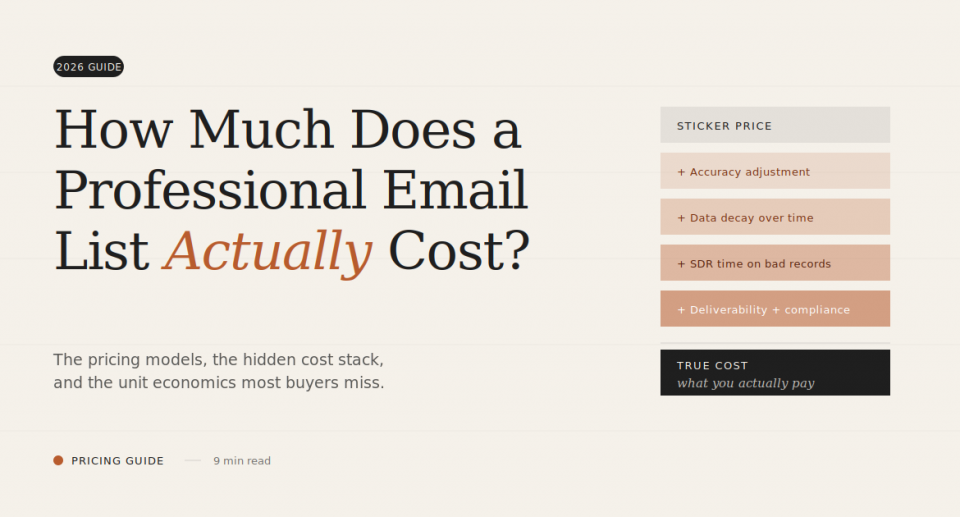
The invoice price of a B2B email list is rarely more than 40% of its true cost. The other 60% lives in places that don’t show up in procurement reviews.
Here’s the full cost stack a finance team should model before approving any list purchase.
Bounce-Related Deliverability Damage
Every hard bounce above 2% degrades your sender reputation. Once your domain reputation drops, even your good emails start landing in spam. Recovery takes weeks. The cost: lost pipeline from emails that never got read, plus the engineering hours to set up warmup sequences and alternative sending domains.
A list with 15% bounces will silently cost you 30 to 60 days of outbound effectiveness across the entire org.
SDR Time Spent on Bad Data
This is the cost finance directors rarely model. If your SDR spends 45 minutes researching a prospect who left the company 8 months ago, that’s $50+ in fully-loaded labor cost per bad record. Multiply that across a 10,000-record list with 25% inaccuracy, and the “cheap” list quietly costs you $125,000 in wasted SDR hours.
The Numbers: Industry research from 2024 to 2025 consistently shows that B2B sales reps spend 27 to 33% of their working time on data cleanup, verification, and correction tasks. That’s roughly one full day per week, every week.
CRM Pollution
Bad contacts don’t just sit there. They get imported, attached to opportunities, sent automated nurture emails, and create false revenue attribution. Cleaning up CRM data pollution typically costs 3 to 5x what it would have cost to buy clean data in the first place.
Compliance and Legal Exposure
In 2026, GDPR, CCPA, CASL, and the new EU AI Act create real liability for using unverified or improperly sourced contact data. Discount providers rarely document their consent chain. When the regulator asks where you got that contact, “we bought a spreadsheet” is not a legally defensible answer.
The fine for one well-publicized violation typically exceeds 10 years of premium data spend.
Opportunity Cost of Bad Targeting
If you spent 6 weeks running outbound to a poorly-targeted list, you didn’t spend those 6 weeks running outbound to the right accounts. The opportunity cost of bad data isn’t just the data spent. It’s the pipeline you didn’t generate because your team was working on the wrong accounts.
Cheap data isn’t cheap. It’s a loan with compounding interest, paid in lost pipeline and damaged sender reputation.
The Unit Economics Framework: Cost Per Usable Contact
The right metric is not “what does this list cost?” It’s “What does this list cost per usable contact, per booked meeting, per generated opportunity?”
Here’s the four-variable framework to calculate the real number.
Step 1: Calculate Accuracy-Adjusted Cost
Take the per-contact price and divide by the accuracy rate.
A list at $0.40 per contact with 70% accuracy has a true cost of $0.57 per usable contact ($0.40 ÷ 0.70). A list at $1.00 per contact with 95% accuracy has a true cost of $1.05 per usable contact.
The “expensive” list is now 1.8x the price, not 2.5x. The gap was closed by 40%.
Step 2: Adjust for Decay
Now adjust for how fast each list decays. B2B contact data decays at roughly 2.1% per month on average, but the rate varies wildly by industry and seniority level (executive turnover is higher).
If you’ll work the list over 6 months, multiply the accuracy by the decay factor. The Tier 2 list’s effective accuracy drops to roughly 56%. The Tier 3 list, which often includes continuous re-verification, remains at 88-90%.
The cost per usable contact gap has just inverted. The “premium” list is now cheaper.
Step 3: Layer in Intent Signal Value
Intent-enriched contacts convert to meetings at 2 to 4x the rate of cold, non-intent contacts. If you’re paying $1.50 per contact for intent-enriched data but converting 3x better, your cost per booked meeting is 50% lower than the $0.40 list’s cost per meeting.
This is where the math fully inverts. The list that looked 4x more expensive is actually 50% cheaper per outcome.
Step 4: Add Hidden Cost Stack
Layer in the SDR time, deliverability damage, CRM pollution, and compliance risk from Section 3. For most teams, this adds 30 to 60% to the effective cost of low-quality data.
The framework in one sentence: Sticker price × (1 / accuracy) × (1 / retention rate over time) × (1 / intent conversion lift) + hidden cost stack = true cost per usable contact.
Run this calculation before your next data purchase. The cheaper list almost never wins.
How to Evaluate a Vendor Before You Spend a Dollar
Pricing is a conversation, not a number. The questions you ask during evaluation determine whether the price you see is the price you pay.
Here are the seven questions every B2B data buyer should ask, in order. Vendors that can’t answer these clearly are telling you something important about their data quality.
You’re looking for: continuous verification, multi-source triangulation, and named methodology. Red flag: “We use industry-standard processes” with no specifics.
You’re looking for: a written guarantee of under 5% (ideally under 3%), with credit or refund if exceeded. Red flag: “We can’t guarantee bounces.”
You’re looking for: clear documentation of opt-in sources, B2B-legitimate-interest framework, or licensed data partnerships. Red flag: vague references to “public sources” with no documentation.
You’re looking for: under 90 days average freshness, with continuous re-verification cycles measured in days or weeks. Red flag: annual or biannual refresh cycles.
You’re looking for: clearly described signal sources (search behavior, content consumption, technographic shifts, hiring patterns, funding events). Red flag: “AI-powered intent” with no source description.
You’re looking for: yes, with realistic data depth. Red flag: “We don’t share samples” or only sharing samples that look hand-curated.
You’re looking for: a clean number you can plug into the unit economics framework. Red flag: complex pricing matrices that obscure the actual per-record cost.