The Impact of Our Cerner Users List on a HealthTech’s Go-to-Market Strategy

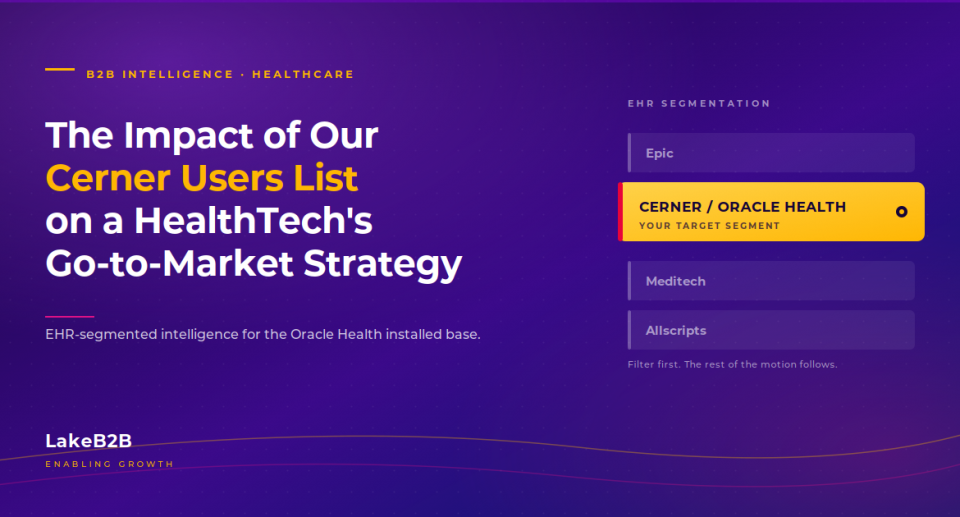
A field guide for HealthTech sales and marketing leaders selling into Oracle Health (Cerner) hospitals, health systems, and federal accounts.
Key takeaway: Treating every hospital as a single addressable market is the most expensive mistake in HealthTech GTM. The Cerner (Oracle Health) installed base behaves nothing like the installed bases of Epic, Meditech, or Allscripts. A verified Cerner users list is not a contact spreadsheet. It is the segmentation layer that decides whether your reps spend a quarter booking demos or burning calendars.
A HealthTech account executive walks into a hospital pitch with a deck built around “native Cerner integration.” Slide three references to PowerChart workflows. The CIO interrupts. The system migrated to Epic eighteen months ago. The meeting ends in seven minutes.
This is the most common failure mode in HealthTech GTM. It has nothing to do with product quality. It has everything to do with treating a fragmented, EHR-defined market as one undifferentiated TAM.
There are roughly 6,100 hospitals in the United States. Per KLAS Research’s acute care EHR reports, four vendors hold the overwhelming majority of inpatient market share. Each one creates a distinct buying ecosystem with its own terminology, integration standards, conference circuit, and decision committee composition. A HealthTech motion calibrated for Epic shops fails predictably in Cerner accounts, and the reverse is equally true.
This article makes the case for treating EHR alignment as the first filter on your account list, not the third. What follows is the four-stage GTM motion we see at work within the Cerner installed base, along with the role a clean, verified, role-targeted Cerner users list plays at each stage.
Why “US Hospitals” Is the Wrong Unit of Segmentation
If your ICP filters on bed count, region, and ownership type but not EHR, your reps are starting every cycle blind.
Most HealthTech CRM segmentation looks like this: bed counts above 200, IDN affiliation, non-profit status, and geography. These filters are useful, but they are second-order. The first-order question is which EHR platform the account runs, because that single fact determines:
- Integration path and timeline. A FHIR-based integration against Oracle Health Millennium ships on a different schedule than one against Epic’s App Orchard. Build estimates, security review timelines, and go-live sequencing, all change.
- Buying committee composition. Cerner shops typically route decisions through a CMIO, a Director of Clinical Informatics, and a CIO. Epic shops route similar decisions through Epic-credentialed analysts and operational owners. The names in the room are different.
- Reference language. Saying “PowerChart” to a Cerner CNIO is fluent. Saying it to an Epic CNIO is a tell that you haven’t done your homework.
- Buying signal sources. Cerner customers attend the Oracle Health Conference (formerly CHC). Epic customers attend UGM. The conferences do not overlap.
- Procurement patterns. Federal accounts on the VA EHR Modernization program operate on a different fiscal cadence and contracting vehicle entirely.
A HealthTech vendor that ignores EHR segmentation is running a single GTM motion across four markets. The result is what shows up in pipeline reviews: long cycles, late-stage losses, AE complaints about “weird friction” no one can diagnose, and forecast slippage no one can explain.
The fix is not better discovery questions. The fix starts from a list that has already been segmented.
The 4-Stage Cerner-Native GTM Motion
Four stages. Each one breaks without a verified Cerner users list as the source data.
We call this playbook Filter, Map, Speak, Time. It is what HealthTech revenue orgs run when their account, role, and signal data are aligned with how Cerner customers actually buy.
Stage 1: Filter (account-level fit)
The first job is removing every account from your TAM that is not on Oracle Health Millennium. This is harder than it sounds. EHR market share is fluid. Hospitals migrate. Systems acquire other systems with different platforms. A hospital file pulled in 2023 already contains roughly 8-12% stale EHR signals, based on our verification runs.
What good looks like at this stage:
- Account list filtered to confirmed Cerner / Oracle Health Millennium installs.
- Recency timestamp on the EHR assignment, not “as of file creation.”
- Subsegmentation by deployment type (acute care, ambulatory, federal, critical access)
- Flag on accounts mid-migration in either direction, because they buy differently
A clean Cerner users list collapses the first two weeks of any account-based motion into a single CSV import. Without it, your SDRs are doing manual EHR research for each account, which they do poorly and inconsistently.
Stage 2: Map (the buying committee)
A Cerner account is not a buyer. It is a committee of five to nine members.
Once the account list is correctly filtered, the next failure mode is reaching the wrong person. HealthTech reps default to the CIO because it’s the easiest title to find on LinkedIn. The CIO is rarely the deal owner.
Inside Cerner accounts, the highest-leverage roles for most HealthTech categories are:
- CMIO (Chief Medical Information Officer). Clinical workflow champion. Owns physician adoption.
- CNIO (Chief Nursing Information Officer). Owns nursing workflow and front-line clinical adoption.
- Director of Clinical Informatics. Often, the actual project owner is involved once a decision is made.
- VP / Director of Revenue Cycle. Critical for RCM, claims, and patient access tooling.
- CIO and CISO. Required for any integration, but rarely the decision driver.
- Service Line VPs. When the use case is condition-specific (oncology, cardiology, women’s health).
Mapping this committee per account, with verified contact data and recent role tenure, is what turns a 14-touch cold sequence into a four-touch warm one. The Lake B2B Cerner users list is built with these roles flagged at the account level, not as a generic title dump.
Stage 3: Speak (Cerner-fluent messaging)
The fastest way to lose a Cerner account is to send Epic-flavored copy.
This is where most marketing automation runs aground. A demand gen team writes one nurture sequence on “EHR-integrated workflows.” It performs poorly across the board. They blame the offer. The offer is fine. The problem is that the copy reads as platform-agnostic, which Cerner buyers read as platform-unaware.
Cerner-fluent messaging references the specifics of the buyer’s lives in: PowerChart, FirstNet, CareAware, the Ignite APIs, HealtheIntent for population health, the new direction under Oracle Health, and the FHIR-based path forward. It acknowledges the things Cerner customers actually complain about and the migrations they actually fear.
This level of specificity is impossible without two inputs: a list of verified Cerner accounts and role-level targeting that lets you write CMIO copy that also does not have to land for a CFO.
The mechanical version of this: segment your nurture by EHR first, role second, use case third. Run separate sequences. The lift in reply rate from this single change typically beats the combined effect of every other email optimization.
Stage 4: Time (when to engage)
Cerner accounts buy on a calendar. The calendar is not yours.
Cerner customers cluster their purchasing and evaluation activities around specific moments: the Oracle Health Conference, fiscal-year planning at the health system, post-migration stabilization windows for newly migrated accounts, and federal contracting cycles for VA, DoD, and IHS accounts on the Oracle Health platform.
A Cerner users list with deployment dates, recent migrations, and recent role changes flagged becomes a timing signal layer. It tells you which CMIO started in the role in the last six months (they are still in their first 100 days, which means they are buying), which IDN just finished a Cerner consolidation across acquired hospitals (they are now in tooling-rationalization mode, which means they are buying), and which federal site just went live on Oracle Health (they need ecosystem tools, which means they are buying).
Treat the list as a static contact dump, and you lose the timing layer entirely. Treat it as a signal feed, and your AE meetings start booking themselves.
Where This Approach Breaks
This motion is not magic. It fails in three predictable ways.
Honesty is part of the playbook. Three failure modes are worth flagging before you commit budget:
- The list is only as fresh as the verification cadence. EHR migrations, role turnover in clinical informatics, and IDN acquisitions quickly degrade any list. A Cerner users list refreshed annually is half-useless within six months. The verification cycle matters more than the initial file size.
- AI SDRs amplify bad data. Point an agentic SDR at a stale or unsegmented list, and you are not running a sophisticated outbound motion. You are running a high-volume mistake. The AI is a coworker. It needs clean intelligence to do its job. The data layer is the deciding variable.
- The Cerner ecosystem keeps shifting under Oracle. Product names, API surfaces, and integration paths have changed since the 2022 acquisition. Messaging built on pre-acquisition Cerner terminology reads dated. Any list provider, ours included, has to be remapped against the current Oracle Health product taxonomy, not the Cerner taxonomy from 2021.
If your list provider cannot speak to these three points, the file is a liability, not an asset.
Check our latest data of email lists
- Physicians User Email List
- Dentists Users Email List
- Nurses Email List
- Hospitals Email List
- Cardiologist Email List
What Changes When the Intelligence Layer Is Purpose-Built
The shift is not from “no list” to “list.” Most HealthTech teams already have a list. The shift is from a generic hospital contact file to a verified, role-mapped, signal-enriched Cerner users list maintained as living infrastructure.
When that intelligence layer is in place, the downstream effects compound. SDR reply rates lift because the messaging finally sounds informed. AE forecast accuracy improves because the pipeline is filtered to accounts that can actually buy. Agentic outbound tools start producing the results their vendors promised, because the input data is finally clean enough for the model to work with.
The Email Data Group Cerner users list is built for exactly this role. Not a directory. The intelligence layer underneath a Cerner-native GTM motion. Verified contacts at the CMIO, CNIO, CIO, clinical informatics, and service line levels. EHR assignment timestamped and refreshed. Federal, acute, and ambulatory deployment types are tagged at the account level. Designed to plug into the systems your reps and your AI agents already use.
The Bridge
The HealthTech vendors who miss the mark this year will not miss it because their products are wrong. They will miss it because their reps and AI agents are running against a list that does not distinguish between an Epic shop and a Cerner shop.
If you sell into Oracle Health (Cerner) accounts and your pipeline shows the symptoms described above, the fix is not another sequence rewrite. The fix is the data layer.
Next step: Request a sample of the Email Data Group Cerner Users List, segmented to your specific HealthTech use case, and run it side-by-side against your current hospital file for one quarter. The delta will not be subtle.