HIPAA-Compliant Healthcare Email List — 95%+ Verified, Opt-In Contacts

A healthcare marketer once asked a vendor for proof that their list was HIPAA-compliant. The vendor sent a one-page PDF with a checkmark logo and the words “HIPAA-Compliant Verified Database.” The marketer’s general counsel laughed for about 90 seconds, then asked one question that ended the deal: “Where’s the Business Associate Agreement?”
The vendor didn’t have one. Of course they didn’t. HIPAA doesn’t work the way most healthcare data vendors imply it does.
Key Takeaway: A truly compliant healthcare email list isn’t governed by one law. It’s governed by a stack of overlapping regulations (HIPAA, CAN-SPAM, CASL, state privacy laws, medical board rules) that vendors routinely simplify into a single marketing claim. Before you buy, you need to know what each layer actually requires, what “95% verified” really means in healthcare contexts, and which compliance shortcuts shift liability from the vendor to your organization.
What HIPAA Actually Says About Email Lists (And What It Doesn’t)
HIPAA does not directly regulate B2B contact databases. This surprises most healthcare marketers when they first hear it from their compliance team. The Health Insurance Portability and Accountability Act governs Protected Health Information (PHI) held by Covered Entities and their Business Associates. It does not, by itself, prohibit anyone from holding or selling the work email address of a hospital procurement director.
The confusion happens because two different things get collapsed into one phrase. There’s HIPAA-regulated data (patient information, treatment records, payment data linked to identifiable individuals), and there’s professional contact data for people who happen to work in healthcare (a physician’s office email, a hospital VP’s direct line, a clinic administrator’s title and number).
A list of NPI-registered physicians with their professional contact details is generally not HIPAA-regulated data. It’s professionally available information about practitioners, similar to how an attorney’s bar registration is public. The “HIPAA-compliant email list” marketing claim usually means something more specific: the vendor has built the list in a way that doesn’t accidentally sweep in PHI, and they handle the data in a manner consistent with HIPAA’s spirit even when not technically required by it.
That’s a meaningful claim. It’s also a much weaker claim than the marketing implies. Two questions to ask:
- Has any PHI ever touched this dataset, even incidentally? (Patient registries, claims data, EHR exports.)
- If so, is there a Business Associate Agreement in place between the vendor and the original source of that data?
If the answer to question one is yes and the answer to question two is no, the list has a compliance problem that no marketing copy can fix.
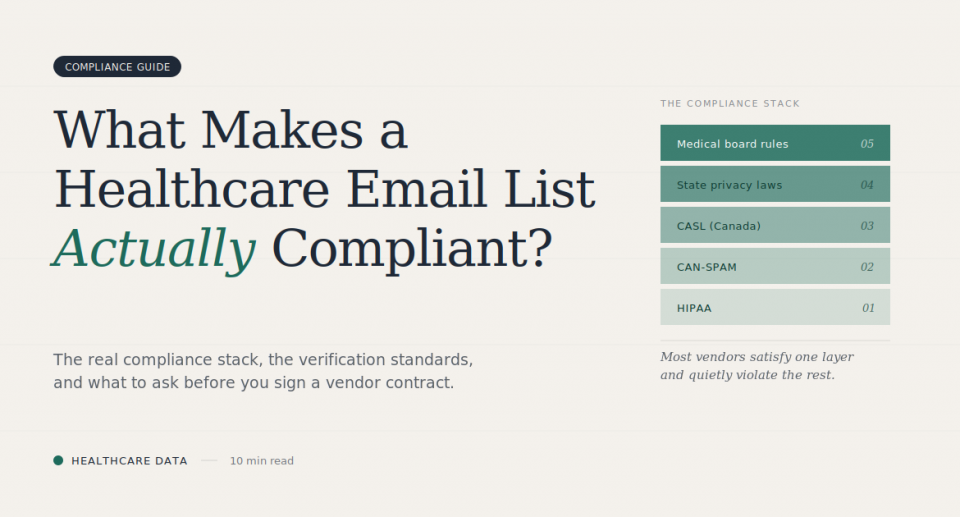
The Real Compliance Stack: 5 Overlapping Regulations
When healthcare marketers ask “is this list compliant?” they’re usually thinking about HIPAA. The actual compliance picture has five layers, and a list that satisfies one layer can still create liability under the other four.
Layer 1: HIPAA (Where Applicable)
Covers PHI held by Covered Entities and Business Associates. If your list includes any data sourced from EHRs, claims systems, patient portals, or pharmacy records, this layer is in play. If it’s purely professional contact data (NPI registry, public licensure boards, conference attendance, professional association directories), HIPAA usually isn’t the controlling law.
Layer 2: CAN-SPAM (US Commercial Email)
This is the law that actually governs your email sends. CAN-SPAM requires accurate sender identification, a clear unsubscribe mechanism, no deceptive subject lines, and a physical postal address in every message. A “HIPAA-compliant” list that creates CAN-SPAM violations is still a compliance failure. Vendors who emphasize HIPAA but don’t discuss CAN-SPAM compliance methodology are signaling where their attention has been.
Layer 3: CASL (Canadian Anti-Spam Law)
If your healthcare list includes any Canadian providers, CASL applies. CASL is stricter than CAN-SPAM. It requires express consent (or qualifying implied consent) for most commercial emails, with documentation of when and how consent was obtained. Many US-focused vendors quietly include Canadian contacts in their lists without ensuring CASL-compliant consent. This is one of the most common hidden liabilities in cross-border healthcare data.
Layer 4: State Privacy Laws
CCPA (California), CPRA, the Virginia CDPA, Colorado CPA, and a growing list of state-level frameworks. Most exempt B2B contact data in narrow contexts, but the exemptions are inconsistent and shifting. The 2024 to 2026 wave of state privacy law expansion has tightened B2B exemptions in several jurisdictions. A list that was compliant in 2023 may not be compliant in 2026 without renewed consent or refreshed sourcing.
Layer 5: Medical Board and Professional Society Rules
Often overlooked. State medical boards, the AMA, specialty societies, and pharmacy boards have their own rules about how their member directories can be used for commercial purposes. A vendor that scraped a state medical board’s licensure database may have technically legal data that violates the licensure agreement under which that data was published. This rarely creates direct legal liability for buyers, but it’s increasingly a reputational issue with sophisticated healthcare clients.
The Numbers: A 2024 analysis of healthcare marketing compliance enforcement actions found that 73% of FTC and state attorney general actions against healthcare data buyers cited CAN-SPAM violations, not HIPAA. The lawsuit risk most buyers are worried about is rarely the lawsuit risk that actually materializes.
A genuinely compliant healthcare email list satisfies all five layers, and the vendor can document compliance for each one separately. Most “HIPAA-compliant” lists in market are actually compliant for one or two layers and silently noncompliant for the rest.
What “95% Verified” Should Mean in Healthcare (and Usually Doesn’t)
The “95% verified” claim is the most common marketing line in healthcare data sales. It’s also one of the most ambiguous. Verified against what, by what method, and at what point in time?
Here’s the verification standard a healthcare list should meet, broken into four checks.
Check 1: NPI Cross-Validation
Every contact who is a clinical provider (physician, nurse practitioner, physician assistant, pharmacist) should be cross-validated against the National Provider Identifier (NPI) registry. The NPI is the only authoritative federal identifier for US healthcare providers. A list that hasn’t been NPI-validated has no business calling itself a healthcare provider list.
A genuinely verified contact record matches: NPI number, current licensure state, specialty, organization affiliation, and active practice status. If any of these are stale, the contact isn’t really “verified” in any meaningful sense.
Check 2: SMTP-Level Email Validation
Not just syntactic validation (the email is correctly formatted), but real SMTP verification: a test connection that confirms the server accepts mail to that address without actually sending an email. This is a technical step many “verified” lists skip. Reputable vendors run continuous SMTP verification cycles, ideally with results no older than 30 to 60 days.
Check 3: Direct Confirmation (For Premium Tiers)
For high-value contacts (department heads, C-suite, key opinion leaders), the strongest verification standard is direct human confirmation: a phone call or research-driven contact to confirm role, organization, and current title within the past 90 days. This is expensive and rare. It’s also what separates a list you can confidently send to from a list you’ll regret.
Check 4: Bounce Rate Guarantee
The verification claim should come with a written commitment. The standard for genuinely high-quality healthcare lists in 2026 is a hard bounce guarantee of under 5%, with refund or replacement remedy if exceeded. Vendors who refuse to guarantee bounce rates are telling you their verification claim is marketing, not methodology.
What “95% verified” should actually mean: 95% of contacts pass all four checks within the past 60 days, the vendor will refund or replace any contacts above the 5% bounce threshold, and the verification methodology is documented in writing as part of the purchase agreement.
A “95% verified” claim without these four supporting elements is a marketing number, not a quality metric. Ask for the underlying methodology. If the vendor can’t produce it, the number is unreliable.
The Opt-In Standard: Three Tiers, Only One Defensible
“Opt-in” is the second most-used phrase in healthcare list marketing. It’s also the most legally consequential. There are three distinct standards that get marketed as “opt-in,” and only one of them holds up under scrutiny.
Tier 1: Express Opt-In (Defensible)
The contact actively and knowingly consented to receive commercial communications from third parties, with documentation of when, how, and what they consented to. This typically comes from professional registration forms, conference attendee opt-ins, publication subscriptions, or vendor-of-record marketplaces where consent for vendor outreach is part of the platform’s terms.
This is the only opt-in standard that survives serious legal review. Documentation should include the timestamp, the source URL or form, the exact consent language, and the IP address of the consenting individual.
Tier 2: Implied Opt-In (Risky)
The contact’s professional role, public listing, or business relationship implies acceptance of professional outreach within reasonable norms. CASL has specific definitions of “existing business relationship” and “existing non-business relationship” that grant time-limited implied consent. CAN-SPAM is more permissive and does not require express opt-in for B2B email.
Implied opt-in is legally defensible in many US contexts but increasingly fragile. State privacy laws are narrowing the implied-consent doctrine. International contacts (Canada, EU) have stricter standards.
Tier 3: “Opted-In Because We Bought It” (Indefensible)
The vendor purchased or licensed the data from another vendor, who purchased it from another vendor, and somewhere in that chain, the original consent (if any) was for a completely different purpose. The current vendor calls this “opt-in” because they themselves did not opt the contact out.
This is functionally the same as cold outreach with extra steps. Most “opt-in” healthcare lists in the budget tier fall into this category. The original consent (if any) was for a job board, a CME platform, or a professional registration, and it never contemplated being resold for commercial email marketing.
A legitimately opt-in healthcare email list can produce, on request, the consent record for any specific contact, including the original opt-in source and date. Vendors who cannot do this are selling Tier 3 lists with Tier 1 marketing language.
How to Audit a Healthcare Email List Vendor Before You Sign
Healthcare data buying carries higher stakes than most B2B segments. A bad SaaS list costs you bounce rates. A bad healthcare list can cost you a state AG investigation. Run every prospective vendor through this 8-point audit before signing.
1. Request the BAA Posture in Writing
Ask: “If our use of this list involves any PHI handling on your platform, are you prepared to sign a Business Associate Agreement?” The right answer is yes, with a sample BAA available. Vendors who don’t know what a BAA is should be eliminated immediately.
2. Ask for Source-Level Provenance
Every contact in the list should have a documented source. Vendors should be able to tell you, for any sample contact, where that record originated (NPI registry, conference attendance, publication subscription, etc.). Vendors who can only tell you “from our database” are flagging that they don’t know either.
3. Demand Methodology Documentation
The verification methodology should be a written document, not a marketing claim. It should specify: what gets verified, how often, against which sources, and what triggers a record’s removal. If this document doesn’t exist, the verification claim doesn’t either.
4. Insist on a Bounce Rate Guarantee
Under 5% hard bounces, written into the contract, with refund or replacement remedy. Vendors who refuse to commit in writing are admitting their verification claim is aspirational.
5. Test a Sample Set First
Before committing to a full list purchase, request a sample of 100 records that match your exact ICP. Run them through your own deliverability tool. Cross-check 10 to 20 records against NPI registry data manually. The sample tells you more than any sales pitch.
6. Verify CAN-SPAM and CASL Compliance Posture
Ask: “Walk me through the CAN-SPAM and CASL provisions and how your data sourcing supports compliance for our sends.” A vendor who treats this as a foreign question doesn’t understand the regulation that will actually govern your email program.
7. Confirm State Privacy Law Posture
Ask specifically about CCPA, CPRA, and any state laws relevant to your target markets. The vendor should be tracking state law evolution as part of their data refresh process.
8. Read the Indemnification Clause Carefully
The contract should include vendor indemnification for compliance failures originating in their data sourcing or verification claims. If they refuse, or if the indemnification has narrow carveouts that exclude the most likely failure modes, walk away.
Vendors who can answer all eight questions with documentation are rare. They are also the only vendors worth buying healthcare data from.
The Bridge: Compliance Is Infrastructure, Not Marketing
The standard for a healthcare email list in 2026 is higher than it was three years ago, and it’s about to get higher still. State privacy laws are tightening. AI-driven outbound is multiplying the consequences of bad data. Healthcare buyers (your prospects) are getting more sophisticated about what compliance actually requires and less tolerant of vendors who clearly don’t meet the bar.
This is where the reframe matters. A healthcare email list is not a file you buy. It is a continuously maintained, multi-layer-compliant intelligence layer that gives your revenue team the legal and technical foundation to do outbound to a regulated industry. The contact data is the surface. The compliance infrastructure underneath is what you’re actually paying for.
This is also what makes healthcare data different from generic B2B data. The verification stack matters more. The consent chain matters more. The methodology documentation matters more. AI-powered prospecting tools, signal-based selling, and ABM motions all amplify the consequences of getting any of this wrong. An AI SDR sending 10,000 emails to physicians on a poorly-sourced list isn’t a marketing problem. It’s a compliance problem that scales at machine speed.
The healthcare contact data, NPI validation, verification methodology, opt-in documentation, and compliance posture should all come from the same provider, working as integrated infrastructure. That’s how you build a healthcare outbound program that holds up to legal review, AG scrutiny, and the increasingly sharp pencils of healthcare buyers themselves.
Before you sign with your next healthcare data vendor, request the eight-point audit documentation referenced above. A vendor who can produce all eight is worth the conversation.
A vendor who can’t has just shown you why the cheap list is never actually cheap in healthcare.