
How AI is Changing B2B Marketing to Tech Users

Why AI Matters in Modern B2B Marketing
Artificial intelligence is no longer an experimental technology reserved for data scientists and large enterprises. It has become a practical, revenue-driving engine for modern B2B marketing, especially in the tech sector.
From automating lead qualification to personalizing complex buyer journeys, AI is reshaping how technology companies attract, engage, and convert prospects.
Tech buyers today are more informed, more independent, and more selective than ever. According to Gartner, B2B buyers spend only about 17% of their time meeting with potential suppliers during a purchase cycle. The rest is spent researching independently, comparing tools, and reading peer reviews. AI helps marketers stay relevant and visible throughout that journey.
This article explores how AI is transforming B2B marketing for tech users, covering personalization, lead generation, content strategy, analytics, and future trends—along with practical insights for marketers ready to adopt it.
The Evolution of B2B Marketing in the Tech Industry
B2B marketing in the tech industry has shifted dramatically over the past two decades. What once relied heavily on cold calls, trade shows, and static email campaigns has evolved into a data-driven, multi-channel ecosystem.
Earlier, segmentation was based on basic firmographics such as company size, industry, or geography. Today, AI-powered platforms analyze thousands of behavioral signals, including website visits, content downloads, webinar attendance, and product usage patterns.
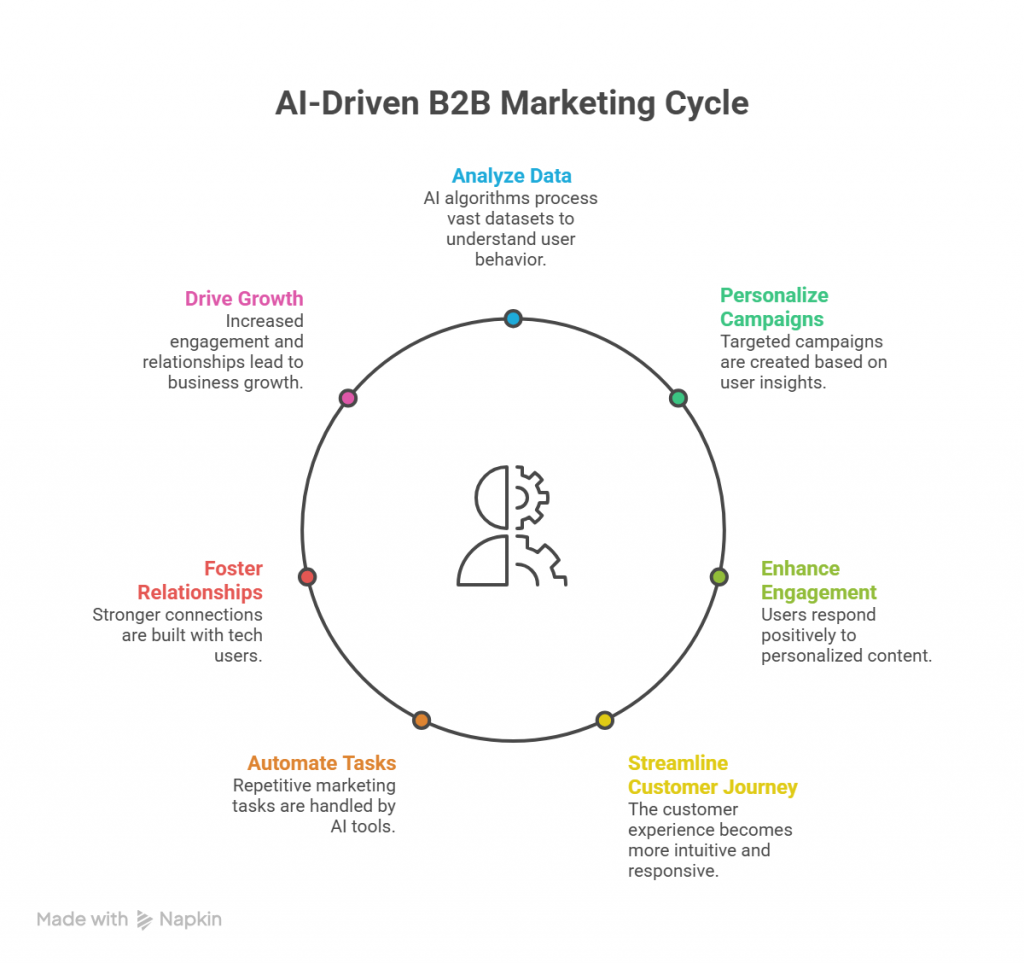
Marketing automation tools like HubSpot, Marketo, and Salesforce Einstein now use AI to:
- Trigger campaigns based on user behavior
- Predict which leads are most likely to convert
- Optimize send times, channels, and messaging
This shift from mass outreach to precision targeting has allowed tech marketers to scale personalization while improving conversion rates and lowering customer acquisition costs.
How AI Understands Tech Buyers Better
Tech buyers leave behind a massive digital footprint. Every search query, product comparison, demo request, and support ticket contributes to a richer data profile.
AI systems analyze this data using:
- Predictive analytics to forecast buying intent
- Natural language processing (NLP) to interpret content engagement and chat interactions
- Machine learning models to identify behavioral patterns
For example, an AI tool may recognize that CTOs who read three cybersecurity blogs and attend a compliance webinar are 40% more likely to request a product demo within 14 days.
This level of insight enables marketers to move beyond generic personas and build dynamic buyer profiles that update in real time as prospects interact with content and campaigns.
AI-Powered Personalization for Tech Audiences
Personalization is no longer limited to inserting a first name into an email subject line. AI now enables hyper-personalized experiences across every touchpoint.
Examples include:
- Dynamic website content that changes based on visitor role, industry, or prior behavior
- Email campaigns customized by job function (CTO vs IT manager vs DevOps lead)
- Real-time content recommendations based on reading history
Netflix-style personalization is now entering B2B marketing. A SaaS platform might show different landing page headlines to a startup founder than to an enterprise CIO, even if they arrive at the same URL.
According to McKinsey, companies that excel at personalization generate 40% more revenue from those activities than average players.
Smarter Lead Generation and Qualification
AI is revolutionizing how B2B marketers identify and prioritize leads.
Instead of relying solely on form fills and manual scoring, AI-driven systems:
- Analyze historical conversion data
- Score leads based on behavioral and firmographic factors
- Identify high-intent prospects before they submit a form
Tools like 6sense and Demandbase use intent data to detect when companies are actively researching specific solutions. This allows sales teams to focus on accounts that are already in-market.
The result is higher-quality pipelines and shorter sales cycles. According to Forrester, companies using AI-based lead scoring report up to 30% higher conversion rates.
Conversational AI and Chatbots in B2B Tech Marketing
Chatbots are no longer basic FAQ widgets. Modern conversational AI can:
- Answer technical product questions
- Schedule demos automatically
- Qualify leads in real time
For example, Drift and Intercom use AI to engage website visitors instantly, capturing leads even outside business hours.
A well-trained chatbot can ask qualifying questions like:
- What problem are you trying to solve?
- What tools are you currently using?
- What is your budget range?
This reduces friction for tech buyers while giving sales teams better-qualified prospects.
AI in Content Marketing for Tech Users
AI has become a strategic assistant for content teams.
It helps with:
- Topic ideation using search and trend data
- SEO optimization and keyword clustering
- Drafting technical articles and product documentation
Platforms like Clearscope, MarketMuse, and Jasper enable marketers to create high-performing content faster while maintaining consistency.
AI also tracks which content assets drive conversions, allowing teams to refine their editorial strategy continuously.
Actionable tip: Use AI analytics to identify which blog posts generate the most demo requests and replicate their structure, tone, and topics.
Account-Based Marketing (ABM) Enhanced by AI
AI has elevated ABM from manual targeting to automated orchestration.
Key enhancements include:
- Identifying high-value target accounts using predictive models
- Coordinating personalized ads, emails, and content across channels
- Measuring account-level engagement in real time
For enterprise tech companies selling six-figure contracts, this level of precision is invaluable.
Example: An AI-powered ABM platform might alert sales when a decision-maker from a target account views a pricing page or downloads a case study.
Read More:- Why Quality Matters: A Deep Dive into the Best Technology Users List Providers
AI-Driven Marketing Analytics and ROI Measurement
Traditional attribution models struggle with long, multi-touch B2B sales cycles.
AI solves this by:
- Analyzing every interaction across channels
- Assigning weighted credit to touchpoints
- Predicting future campaign performance
According to Deloitte, organizations using AI-driven analytics are twice as likely to report significant improvements in marketing ROI.
Actionable insight: Use AI to forecast which campaigns will generate the highest pipeline value and reallocate budgets accordingly.
Challenges and Ethical Considerations
Despite its benefits, AI adoption comes with risks.
Major challenges include:
- Data privacy compliance (GDPR, CCPA)
- Algorithmic bias
- Over-automation that removes human judgment
Ethical AI practices require transparency, consent, and continuous monitoring.
Best practice: Maintain a human-in-the-loop approach for critical decisions like pricing, segmentation, and campaign messaging.
Future Trends: Where AI in B2B Tech Marketing Is Headed
The next wave of AI innovation will focus on:
- Autonomous marketing platforms
- Hyper-personalized buyer journeys
- Deeper integration between marketing, sales, and product teams
AI copilots will soon recommend campaign strategies, content topics, and budget allocation automatically.
According to IDC, global spending on AI marketing technologies is expected to exceed $100 billion by 2028.
Read More: Why a High-Quality B2B Email List is the Key to Higher Conversions?
How B2B Tech Marketers Can Get Started with AI
AI is no longer optional for B2B tech marketers.
To get started:
- Audit your existing data infrastructure
- Pilot AI tools for lead scoring or personalization
- Train your team on AI capabilities and limitations
The companies that adopt AI early and responsibly will gain a long-term competitive advantage.
In an industry where innovation defines leadership, AI is not just a tool—it is the foundation of modern B2B marketing.
Frequently Asked Questions
AI is transforming B2B marketing by automating lead scoring, personalizing content at scale, and predicting buyer intent. For tech companies, this means faster sales cycles, more accurate targeting of IT decision-makers, and higher-quality leads through data-driven campaigns.
The main benefits of AI in B2B marketing include improved lead quality, better personalization, real-time campaign optimization, and more accurate forecasting. AI helps tech marketers reduce manual work while increasing conversion rates and marketing ROI.
AI improves personalization by analyzing user behavior, firmographic data, and engagement patterns to deliver tailored emails, ads, and website experiences. In B2B tech marketing, this helps brands speak directly to the needs of CIOs, developers, and IT managers.
No, AI is not replacing human marketers. Instead, AI supports marketers by handling repetitive tasks, analyzing large datasets, and providing insights. Human creativity, strategy, and relationship-building remain essential in B2B tech marketing.
Common AI tools in B2B marketing include predictive analytics platforms, AI-powered CRMs, chatbots, programmatic advertising tools, and marketing automation software. These tools help tech companies generate leads, nurture prospects, and optimize campaigns more efficiently.