B2C Email Lists: What You’re Actually Buying When You Buy One

It’s launch week. You bought a B2C email list of 100,000 consumers who, on paper, match your buyer. You upload it, hit send, and watch the dashboard. Within an hour, 22,000 bounce, your spam complaint rate crosses 0.4%, and Gmail starts routing the rest to the junk folder.
By Friday, even the emails to people who actually opted in are landing in spam. The list cost you $2,000. The damage to your sending domain will cost you months.
That is the gap nobody explains when they sell you a B2C email list. The list is easy to buy. Making it work is the hard part, and most of what determines whether it works is invisible at the point of purchase.
Key Takeaway: A B2C email list is not a pile of addresses you buy and blast. It is a permissioned, verified, attributed consumer audience. Vet it on permission, accuracy, coverage, and enrichment before a single send, or the cheap list will quietly cost you your inbox placement.
What a B2C Email List Actually Is (and Why “List” Is the Wrong Word)
A B2C email list is a collection of personal email addresses belonging to individual consumers, paired with the attributes that let you target and personalize: demographics, location, purchase history, and interests. That is the textbook answer. The useful answer is that the word “list” hides everything that matters.
A flat list of addresses is a liability. What you actually want is an audience: a defined group of consumers who can legally receive your email, whose addresses are real and current, and who carry enough attached data to be segmented.
The difference between those two things is the difference between a campaign that builds a pipeline and one that burns your domain.
There are two ways to get a B2C list, and they are not equal. An owned list is built from your own opt-ins: newsletter signups, checkout flows, and account registrations.
A purchased or rented list comes from a third-party data provider. Owned lists perform better because the consumer already knows you. Purchased lists scale faster, but they carry permission and accuracy risks that you inherit the moment you press send.
The asset is never the addresses. The asset is the permission and the accuracy behind it. Treat a B2C list as a database you are responsible for, not a commodity you consume, and most of the downstream pain disappears.
B2C vs B2B Email Lists: The Differences That Change How You Use Them
B2C and B2B lists look identical in a spreadsheet and behave nothing alike in the inbox. A B2B list targets a person in their work role at a company, so the buying logic is rational, multi-stakeholder, and slow.
A B2C list targets a person as an individual, so the logic is emotional, fast, and singular. That single difference cascades into everything.
Three operational gaps matter most:
- Inbox provider. B2B addresses sit behind corporate mail servers and Microsoft 365. B2C addresses sit behind Gmail, Yahoo, and Apple, which apply far more aggressive consumer spam filtering and engagement scoring. A list that performs in B2B can collapse in B2C purely because of who runs the mailbox.
- Privacy law. B2C contacts are protected as individuals under regulations like GDPR and CCPA. Many B2B contacts at a business address get treated differently under those same laws. The legal exposure on a consumer list is structurally higher.
- Scale and decay. B2C lists are larger and decay faster. People change their personal addresses, abandon old inboxes, and unsubscribe on a whim. A six-month-old consumer list is not the list you bought.
You cannot run a B2C list with a B2B playbook, because consumer inboxes punish volume and reward relevance far more harshly. If you have only ever done B2B email, assume your deliverability instincts are wrong here until proven otherwise.
The Hidden Cost of a Cheap B2C List: Deliverability, Reputation, and Law
A cheap B2C list is the most expensive thing in marketing, because the price you pay is not in dollars, it is in deliverability you cannot buy back. Mailbox providers no longer just filter individual messages.
They score your sending domain over time, and a single bad campaign can suppress your good campaigns for weeks.
This stopped being a soft risk in 2024. Under Google and Yahoo’s bulk sender requirements, anyone sending to consumer inboxes at volume must authenticate their domain with SPF, DKIM, and DMARC, offer one-click unsubscribe, and keep spam complaint rates below a hard threshold.
The Numbers: Google and Yahoo’s 2024 bulk sender rules require spam complaint rates to stay below 0.3%, with 0.1% as the real target (Google, Email Sender Guidelines, 2024). A purchased list that triggers complaints above that line can throttle delivery for every email you send, including to subscribers who opted in.
The legal exposure is the second hidden cost, and it is not theoretical. The penalties attached to consumer email and data are large enough to change the math on a “bargain” list.
The Numbers: GDPR allows fines up to 20 million euros or 4% of global annual revenue, whichever is higher (GDPR, Article 83). U.S. CAN-SPAM violations can exceed $50,000 per individual email under FTC enforcement. One non-compliant list can carry more liability than its entire campaign will ever earn.
A list with no documented consent is not a discount; it is an unpriced risk you are absorbing on someone else’s behalf. When a provider cannot show you where the permission came from, assume there is none and price the list at what that exposure is worth, which is usually zero.
The PACE Framework: How to Vet or Build a List That Converts
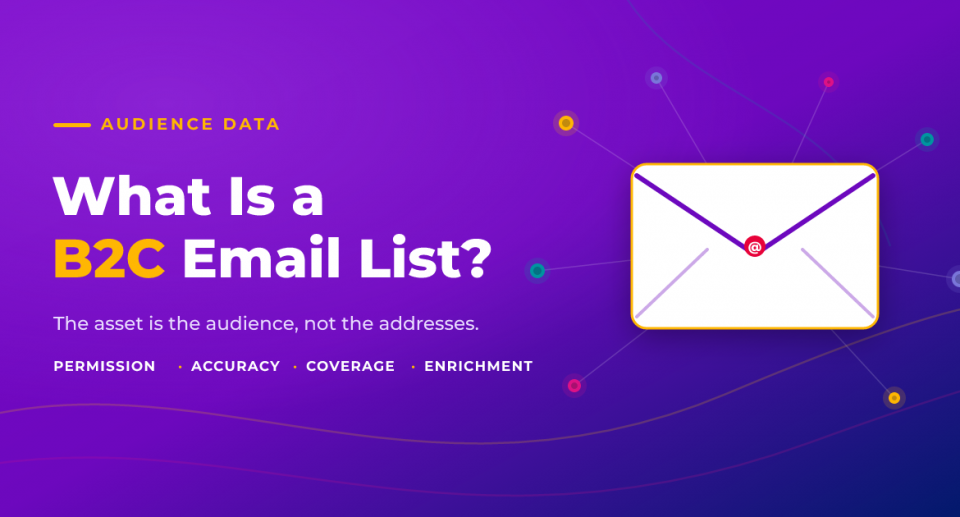
Before you buy or send any B2C list, run it through PACE: Permission, Accuracy, Coverage, Enrichment. These are the four layers that decide whether a list generates revenue or generates complaints, and you can check all four before a single email goes out.
1. Permission. Ask the provider one question: where did the consent come from, and can you document it per record? Opt-in provenance is the single highest predictor of deliverability. If the answer is vague, the list fails here, and the other three layers do not matter.
2. Accuracy. Run the file through email verification before you ever load it into your platform. Expect a meaningful share of an unvetted consumer list to be invalid, role-based, or spam-trap addresses. A list that has not been validated in the last 90 days should be treated as stale.
3. Coverage. Coverage is fit, not size. A list of 30,000 people who match your actual buyer beats 100,000 random consumers every time. Filter against your real audience attributes, such as geography, age band, household, and purchase behavior, and judge the list by overlap with your ICP rather than by raw count.
4. Enrichment. A raw address cannot be personalized. Enrichment appends the signals that let you segment and speak to one person: lifestyle data, purchase intent, channel preference, and life-stage indicators. Without it, you send one generic message to everyone, which is exactly what consumer inboxes filter hardest.
Here is what PACE changes in practice. A raw 100,000-record list might leave you with 78,000 deliverable addresses and a handful of engaged openers, while quietly damaging your domain.
The same budget spent on a 30,000-record list that clears all four layers yields roughly 29,000 deliverables, sharply higher engagement, and no reputation hit.
Stop optimizing for list size and start optimizing for the percentage that passes PACE. That single shift is the difference between a channel that scales and one you have to keep rebuilding.
Why Your AI Marketing Stack Is Only as Good as the List Under It
Every AI feature you are adding to email in 2026, such as send-time optimization, subject-line generation, predictive segmentation, and automated personalization, runs on the data in your list.
Feed those agents a decayed, non-consented file, and you have not automated marketing. You have automated spam, at machine speed, against your own domain.
Think of an AI marketing agent as a new hire with no judgment about data quality. It will personalize a message to a contact who left that email address two years ago.
It will optimize send time for a spam trap. It will scale whatever you give it, and if what you give it is a bad list, it scales the damage faster than any human ever could.
The question is not whether to use AI in your B2C email program. It is whether the list underneath it is clean enough to make the AI worth running at all.
An AI agent with a verified, enriched, permissioned audience is a force multiplier. The same agent with a purchased blast list is an expensive way to land in the spam folder. The data layer is not the boring part of the stack. It is the part that decides whether everything above it works.
The List Was Never the Point
The shift in B2C email is not from manual to automated. It is from owning a list to earning an audience. The marketers winning consumer inboxes are not the ones with the biggest files.
They are the ones whose data is permissioned, current, and rich enough that both their team and their AI tools can act on it with confidence.
To run PACE end-to-end, you need four things working together: documented consent, continuous verification, ICP-level coverage, and behavioral enrichment.
That is not something you get with a one-time list purchase. It is a data capability, and it is the difference between renting addresses and building an audience asset you control.
That capability is what EmailDataGroup provides. Not a list to blast, but a verified, consent-compliant, enriched consumer audience matched to the exact buyer you are trying to reach, so your campaigns and your AI tools have something solid to stand on.